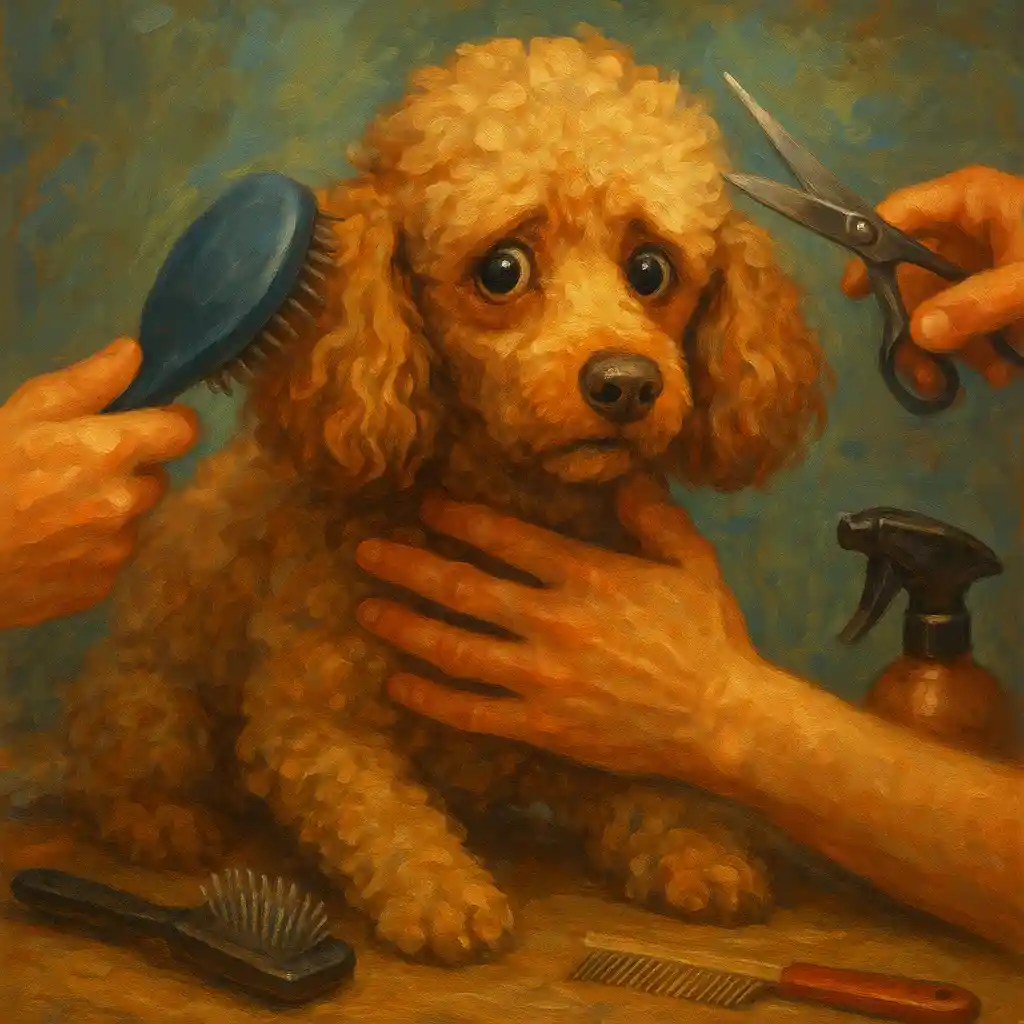
Poodle anxiety during grooming is common, and it can feel exhausting for both you and your dog. Many poodles become worried when they see a brush, hear clippers, or feel hands holding them still. The good news is that you can help. With a simple desensitization plan, cooperative care, and a few helpful home tools, you can turn grooming into a calmer, safer routine.
When you treat grooming like training (not a battle), poodle anxiety during grooming can improve step by step.
This article will help you understand why poodles get anxious, what signs to watch for, and how to build a grooming routine that feels more predictable and positive. You will learn how to introduce tools slowly, how to reward cooperation, how to set up a calm space at home, and when it makes sense to get professional help.
Understanding poodle anxiety during grooming
Poodle anxiety during grooming usually comes from fear, surprise, discomfort, or past experiences. Grooming asks a dog to accept strange sounds, new sensations, and close handling of sensitive areas like paws, ears, face, and tail. Even a friendly poodle can struggle if grooming feels confusing or too fast.
It also helps to remember that anxiety is not “bad behavior.” It is information. Your poodle is telling you something feels scary, uncomfortable, or unsafe. When you listen to those signals, you can change the plan and build trust.
Common triggers of poodle anxiety during grooming
Many poodles react to the same types of triggers. These are some of the most common:
- Sounds like clippers, hair dryers, or even nail clippers clicking.
- Restraint (being held still, having a chin held, or being lifted onto a surface).
- Sensitive body areas like paws, nails, ears, face, and tail.
- Unfamiliar handling from a new person or in a new place.
- Long sessions that go on until your poodle is overwhelmed.
Some poodles also become anxious if the grooming setup feels slippery or unstable. A dog that is worried about falling may fight the process, even if the grooming itself is gentle.
Signs of anxiety in poodles during grooming sessions
Poodle anxiety during grooming can look obvious, but sometimes it is subtle at first. Watch for:
- Trembling or shaking
- Panting when it is not hot
- Trying to escape, pulling away, or hiding
- Growling, snapping, or showing teeth
- Freezing or becoming very still
- Whining, barking, or constant licking
- Turning the head away or avoiding eye contact
These signs matter because they often come before bigger reactions. If you notice early stress signals and pause, you can prevent the situation from getting worse.
How anxiety affects grooming and your poodle’s well-being
Poodle anxiety during grooming can make basic care harder: brushing takes longer, mats get worse, nail trims become stressful, and bath time turns into a struggle. Over time, this can affect health and comfort. Regular grooming supports skin, coat, nails, ears, and overall hygiene. When grooming becomes too stressful, dogs may miss important care or only get groomed when problems are already serious.
It also affects your relationship. If grooming always ends in fear, both you and your poodle may start to dread it. The goal is not perfect grooming right away. The goal is a routine that builds safety and trust.
A desensitization plan for poodle anxiety during grooming
A desensitization plan means you introduce grooming in tiny steps that feel safe. You do not rush. You do not force. You teach your poodle that grooming tools and grooming actions predict good things.
This approach is especially helpful for poodle anxiety during grooming because it changes the emotional response. Instead of “brush = scary,” your poodle learns “brush = treats, praise, calm time, and breaks.”
Step-by-step: desensitizing your poodle to grooming procedures
- Start with calm exposure: Show the tool from a distance. Let your poodle look at it. Reward calm behavior.
- Let your poodle investigate: Allow sniffing. Do not move the tool toward your dog quickly. Reward curiosity.
- Add gentle touch without grooming: Lightly touch the shoulder or back with the brush (no brushing yet). Reward.
- Do one small action: One brush stroke, then treat. Stop before your poodle gets stressed.
- Increase time slowly: Add a few seconds at a time across many sessions.
- Practice sounds separately: Turn clippers on and off far away, then closer over time, always paired with rewards.
- Rotate areas: Work on easy areas first (back, sides), then slowly move to harder areas (legs, paws, face).
- End on a win: Stop after a successful small step, not after a struggle.
Short sessions are powerful. Even 30 to 90 seconds done regularly can help reduce poodle anxiety during grooming more than one long session that ends with stress.
Start with positive associations
Before you ask for grooming, teach your poodle that the grooming area and grooming tools mean good things. You can place the brush on the floor, let your poodle approach, and give a treat. Repeat. The brush does nothing “bad,” and your dog gets rewarded for being near it.
This is a simple way to begin changing the story around poodle anxiety during grooming. Your poodle is not being “tricked.” Your poodle is learning that grooming items are safe.
Gradual exposure to tools and procedures
Gradual exposure means you do not jump from “sniff the brush” to “full brushing session.” You move in small steps. If your poodle shows stress, you go back one step.
For example, if your poodle can handle one brush stroke on the back, stay there for a while. Build confidence. Then add a second stroke. Then three. Then move to a new area.
With poodle anxiety during grooming, slow progress is still progress. Consistency matters more than speed.
Reward-based training techniques
Rewards help your poodle understand what you like and help your poodle feel safe. During grooming practice, reward:
- Standing still for one second
- Looking at the tool calmly
- Letting you touch a paw
- Allowing one brush stroke
- Relaxing on a mat
Use treats, gentle praise, and breaks. The reward should come quickly, especially at the start. This is one of the most effective ways to reduce poodle anxiety during grooming without force.
Building trust and confidence through desensitization
Trust grows when your poodle learns that you will listen. If your dog pulls away, you pause. If your dog is calm, you continue. This clear pattern helps your poodle feel safer because your dog can predict what will happen.
Trust is built when your poodle learns: “I can say I need a break, and my person will respect it.”
As confidence grows, you will often see your poodle offer more cooperation. That leads directly into the next key piece: cooperative care.
Cooperative care for poodle anxiety during grooming
Cooperative care means grooming becomes something you do with your poodle, not to your poodle. You teach simple skills that help your dog participate and feel more in control. This can dramatically reduce poodle anxiety during grooming because it lowers panic and builds clear communication.
Why cooperative care reduces anxiety
Many dogs get anxious when they feel trapped. Cooperative care gives your poodle a job and a predictable routine. Instead of guessing what will happen, your poodle learns signals like “chin rest,” “stand,” or “paw.” When your dog can do a trained behavior, your dog often feels safer and calmer.
Tips for establishing cooperative care with your poodle
- Work in tiny steps and reward frequently.
- Teach a start and stop signal (for example, your poodle puts their chin on a towel to say “ready”).
- Use breaks before your poodle gets overwhelmed.
- Keep your body language calm and your voice gentle.
- Practice when you are not grooming, so the skills are strong when you need them.
These habits can change the emotional tone of grooming and reduce poodle anxiety during grooming over time.
Positive reinforcement training during grooming
Positive reinforcement is not only for “sit” and “stay.” It works for grooming skills too. Reward your poodle for:
- Placing their chin in your hand or on a towel
- Standing on a mat
- Letting you lift a paw for one second
- Allowing you to touch an ear gently
When you reward these calm moments, you teach your poodle what cooperation looks like. This is one of the simplest ways to improve poodle anxiety during grooming without pushing too far.
Building a grooming routine your poodle can predict
Dogs feel safer when routines are predictable. Try to groom in the same place, with the same steps, and the same calm pace. For example:
- Go to the grooming area
- Offer a treat
- Show the tool
- Do 10–30 seconds of grooming
- Take a short break
- Repeat if your poodle is still comfortable
This structure helps reduce poodle anxiety during grooming because your poodle learns what comes next and learns that breaks are part of the plan.
Understanding your poodle’s body language
Your poodle’s body language is your best guide. If you see stress signs like turning away, lip licking, yawning, freezing, or trying to leave, pause. You can offer a break, lower the difficulty, or end the session.
When you respond to body language, you prevent grooming from becoming a fight. That is a big step toward reducing poodle anxiety during grooming and keeping everyone safe.
Home tools to reduce poodle anxiety during grooming
Home tools do not replace training, but they can make grooming easier and more comfortable. The right tools can reduce pulling, reduce noise, and help your poodle feel more stable. This matters a lot when you are working on poodle anxiety during grooming.
Essential grooming tools for poodles
These are common home tools mentioned throughout many poodle grooming routines:
- Slicker brush for tangles and early mat prevention
- Stainless steel comb (wide and narrow teeth) for checking for knots
- Electric clippers designed for thick, curly coats
- Nail clippers made for dogs
- Ear cleaner to support ear hygiene
Using gentle, well-made tools can help reduce discomfort, which can lower poodle anxiety during grooming.
Choosing the right tools for your poodle’s coat type
Poodles can have different coat styles and needs. Tool choice matters:
- Curly or woolly coat: a slicker brush can help prevent tangles and matting.
- Corded coat: a metal comb can help with careful maintenance.
- Straight or wavy coat: a pin brush may help keep the coat smooth.
When the tool fits the coat, grooming is faster and less frustrating. That can reduce poodle anxiety during grooming because there is less pulling and fewer long sessions.
How to introduce grooming tools at home
Introducing tools is part of training. Use the same slow steps you use in your desensitization plan:
- Place the tool nearby and reward calm behavior.
- Let your poodle sniff it and reward curiosity.
- Touch the tool gently to the body without grooming and reward.
- Do one small grooming action and reward.
Keep sessions short. If your poodle gets worried, go back to an easier step. This is a practical way to address poodle anxiety during grooming without pressure.
DIY grooming techniques for poodle owners
You can do a lot at home, especially between professional grooming appointments. Simple DIY care can help prevent problems that make grooming harder later.
- Brush regularly to reduce tangles and mats.
- Check ears and keep them clean with a gentle routine.
- Trim nails in tiny steps instead of trying to do all nails at once.
- Brush teeth as part of overall care, using gradual training.
If poodle anxiety during grooming is high, choose one small task per day. Small, calm practice is better than one big stressful session.
Creating a safe and calm grooming environment for poodle anxiety during grooming
The environment can either help or hurt. A calm setup supports calm behavior. If your poodle feels unstable, rushed, or surprised, anxiety grows. If your poodle feels safe, steady, and rewarded, anxiety often decreases.
Why a calm environment matters
Poodle anxiety during grooming can rise quickly when the space is loud or busy. A quiet room, gentle handling, and a predictable routine can make grooming feel less threatening. You can also help by staying calm yourself, because dogs often notice our tension.
Tips for a stress-free grooming space at home
- Choose a quiet area with good light.
- Use a non-slip mat so your poodle feels stable.
- Keep tools ready so you are not searching mid-session.
- Reduce distractions like loud TV or lots of people walking in and out.
- Use short sessions and plan breaks.
These simple changes can support your training and reduce poodle anxiety during grooming because your poodle can relax more easily.
Ensuring safety during grooming sessions
Safety always comes first. If your poodle is panicking, biting, or trying to jump away, stop and reassess. Do not force the session. Instead:
- Return to easier steps in your desensitization plan.
- Use cooperative care skills and reward calm moments.
- Choose tools that feel gentle and are sized for your dog.
- Take breaks and end early if needed.
When you protect safety, you also protect trust. That trust is essential for reducing poodle anxiety during grooming long term.
When poodle anxiety during grooming needs professional help
Sometimes, home practice is not enough on its own. Professional support can be a smart, caring choice. A groomer can help with technique and handling, and a behaviorist can help with a plan for fear and anxiety.
Signs your poodle may need professional intervention
- Your poodle becomes extremely anxious, shuts down, or panics.
- Your poodle shows aggression during grooming (growling, snapping, biting).
- You cannot safely trim nails, brush mats, or clean ears at home.
- Your poodle’s stress is getting worse over time, not better.
Getting help is not failure. It is often the fastest way to improve poodle anxiety during grooming while keeping everyone safe.
Benefits of working with a groomer or behaviorist
A professional groomer can handle grooming tasks efficiently and safely. They may also show you how to brush, comb, or clip in a way that is more comfortable for your poodle.
A behaviorist or qualified trainer can help you build a step-by-step plan for poodle anxiety during grooming, including how to work with triggers like clippers, dryers, restraint, and sensitive handling.
How to find the right professional for your poodle
Look for someone who understands anxious dogs and supports gentle handling. You want a professional who respects your poodle’s signals and who is willing to work with your training plan. If your poodle has specific triggers, share them clearly so the professional can adjust the approach.
You can also keep doing short, positive home practice between appointments. Home practice supports long-term progress with poodle anxiety during grooming.
Real-life progress: what poodle anxiety during grooming can look like over time
Many poodle owners start with a dog that trembles, hides, or fights grooming. With steady practice, things can change. Real-life stories often follow the same pattern: small steps, lots of rewards, and a routine that respects the dog’s pace.
Examples of successful changes
- A poodle who hid from brushes becomes comfortable when the brush is introduced during calm moments with treats and praise.
- A poodle who snapped during grooming improves when grooming becomes cooperative care, with clear breaks and rewards for calm participation.
- A poodle with past bad experiences relaxes more when grooming is done at home with gentle tools, short sessions, and frequent pauses.
These kinds of changes are possible because poodle anxiety during grooming is not fixed. It can improve when the dog feels safe and understood.
Lessons to remember
- Go slower than you think you need to.
- Reward calm behavior often.
- Stop before your poodle is overwhelmed.
- Choose comfort and safety over “finishing the job.”
Each small win matters. Calm grooming is built over time.
Maintaining progress with poodle anxiety during grooming: consistency and patience
Progress is not always a straight line. Some days will be easier than others. The key is to keep practice gentle, regular, and realistic. Poodle anxiety during grooming often improves when your poodle learns that grooming is predictable and safe.
Why consistency matters
Short, regular sessions help your poodle remember the routine and keep skills fresh. If grooming only happens once in a while and always takes a long time, your poodle may feel surprised and stressed each time.
Consistency supports both desensitization and cooperative care, and it helps reduce poodle anxiety during grooming because your poodle knows what to expect.
Practicing patience throughout the process
Patience is not just “waiting.” It is choosing steps your poodle can handle. If your poodle struggles, it does not mean your poodle is being stubborn. It usually means the step is too hard right now.
Break tasks into smaller pieces. Do fewer minutes. Take more breaks. Use more rewards. These choices help poodle anxiety during grooming improve without pressure.
Celebrate small victories and milestones
Celebrate the small moments: one calm brush stroke, one paw touch, one nail clipped, one minute on the grooming mat. Those are real milestones. Over time, they add up to a poodle who feels safer during grooming.
Small wins are the foundation of big change with poodle anxiety during grooming.
Addressing health issues and anxiety triggers linked to poodle anxiety during grooming
Sometimes anxiety is not only emotional. Discomfort can play a big role. If grooming hurts, your poodle may resist more strongly. It is important to notice possible health issues and address them early.
Health issues that may contribute to grooming anxiety
- Skin irritations or allergies that make brushing painful
- Joint pain or arthritis, especially in older poodles, making certain positions uncomfortable
- Ear infections that make ear handling painful
- Dental problems that make face handling stressful
If you suspect pain, do not push through. Pain can increase poodle anxiety during grooming and can also create long-term fear around grooming tools.
Strategies to address underlying issues
Regular check-ups can help you catch problems early. If your poodle suddenly becomes more sensitive, consider whether something might be hurting. Adjust grooming to be gentler and shorter while you figure out the cause.
Even when health is not the main issue, comfort-focused grooming still helps reduce poodle anxiety during grooming.
Working with a veterinarian on anxiety triggers
Your veterinarian can help you think through triggers and possible causes. Bring clear notes about what your poodle reacts to (clippers, nail trims, brushing, ear cleaning, restraint). A vet can also help you decide if there are medical concerns that make grooming uncomfortable.
When you combine medical support with training, you give your poodle the best chance to improve poodle anxiety during grooming.
Relaxation techniques that support poodle anxiety during grooming
Beyond brushing and clipping, relaxation skills can help your poodle enter grooming in a calmer state. These techniques do not replace desensitization or cooperative care, but they can support them.
Benefits of relaxation for anxious poodles
Relaxation helps your poodle recover faster from stress and stay calmer during handling. When your poodle is calmer, learning is easier. And when learning is easier, poodle anxiety during grooming often improves more quickly.
Simple relaxation exercises before and during grooming
- Calm petting: slow, gentle strokes in areas your poodle enjoys.
- Quiet voice: speak softly and keep your movements smooth.
- Short breaks: pause for a few seconds, offer a treat, then continue if your poodle is still comfortable.
- Tool-free practice: practice standing on the mat and being touched without grooming, just for rewards.
These simple habits can make a real difference for poodle anxiety during grooming, especially when used consistently.
Creating a calming grooming routine
A calming routine is one your poodle can predict and succeed in. Keep it simple:
- Same place, same mat, same basic steps
- Tools introduced slowly
- Lots of rewards for calm behavior
- Short sessions with breaks
- End on a positive note
When grooming becomes calm and predictable, poodle anxiety during grooming often decreases naturally over time.
Conclusion
Poodle anxiety during grooming can feel overwhelming, but it is something you can work on with steady, kind practice. Use a desensitization plan to introduce tools and steps slowly, build cooperative care so your poodle feels involved, and set yourself up with simple home tools and a calm space. With patience and consistency, grooming can become a safer, more positive part of your routine.
If you want to make this easier to follow, create a weekly plan with short sessions and track your small wins—then keep building from there. For more support, check out our other training and grooming guides on the site and start a simple routine you can stick with.