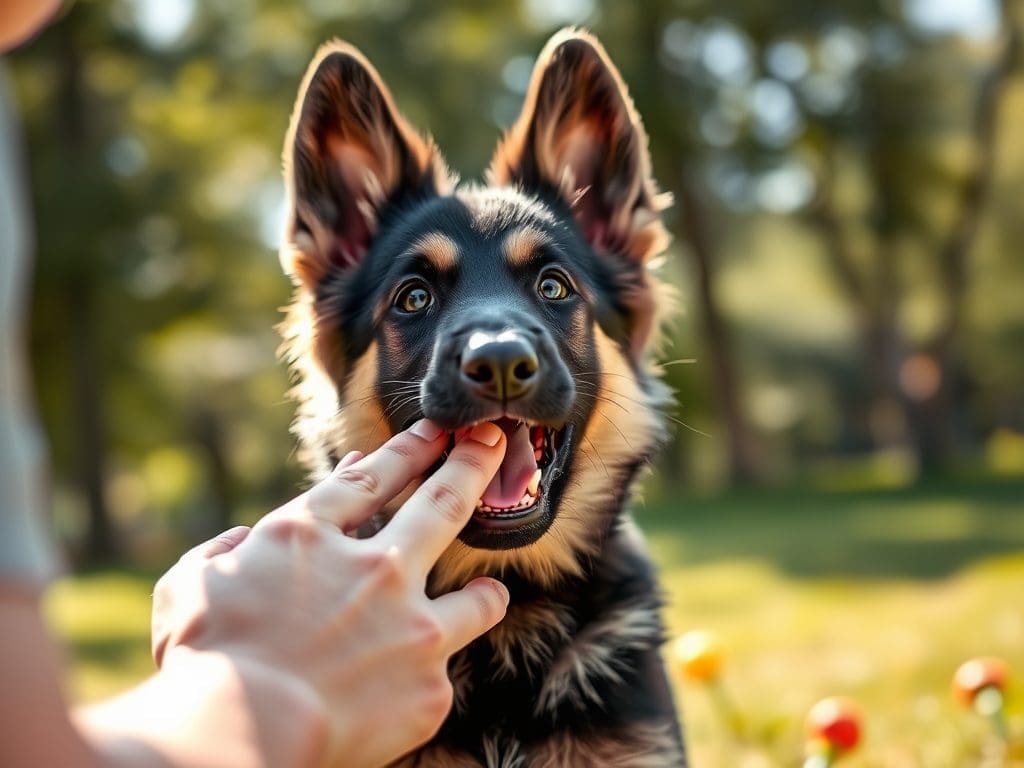
German Shepherd puppies are smart, energetic, and full of drive. They also explore the world with their mouths. That is why many new owners feel like they brought home a tiny “land shark.” The good news: GSD Puppy Bite Control is a skill you can teach in a kind, structured way. You do not need harsh tools. You need a clear plan, good timing, and steady routines.
This blog entry gives you a complete 8–12 week training plan built around three simple ideas:
- The Yelp Method (clear feedback: “too hard”)
- Redirection (teach what to bite instead)
- A gradual “No Hands” approach (hands are not toys)
It also includes safety tips (especially helpful for seniors), toy suggestions, daily schedules, socialization support, and solutions for common problems.
What “bite control” really means (and what it does not)
GSD Puppy Bite Control does not mean your puppy will never use their mouth. Puppies naturally mouth during play, teething, and excitement. The goal is to teach two important life skills:
- Bite inhibition: Your puppy learns to keep their mouth gentle and soft.
- Bite choices: Your puppy learns what is okay to bite (toys, chews) and what is not (hands, clothes, ankles).
A puppy that learns bite control early usually becomes an adult dog that is safer, calmer, and easier to handle. This matters even more for a strong breed like a German Shepherd.
Why German Shepherd puppies often bite more
Many German Shepherd puppies bite more than other breeds for a few normal reasons:
- High energy and high arousal: They get excited fast and can “spill” energy through their mouth.
- Working-breed instincts: Shepherds are bred to use their body and mouth in action (herding, gripping, carrying).
- Fast learning: They quickly repeat behaviors that “work” (for example: biting makes you move, shout, or wave your hands).
- Teething discomfort: From about 12 weeks onward, chewing often increases.
None of this means your puppy is aggressive. Most puppy biting is normal. Still, you must train it early because German Shepherds grow quickly and their mouth becomes powerful.
Before you start: two important rules for success
Rule 1: Your timing matters more than your strength
For GSD Puppy Bite Control, the best feedback happens within 1–2 seconds of the bite. If you react late, your puppy may not understand.
Rule 2: Every bite must have a predictable result
Your puppy learns faster when the outcome is always the same:
- Gentle play = play continues
- Hard bite = play stops / attention stops
- Chewing a toy = praise and rewards
Consistency is the “secret ingredient.”
Set up your home for safer training (puppy-proofing for bite control)
Good training is much easier when the environment helps you. Prepare these basics:
Keep bite-safe items everywhere
Place a few toys in every room where you spend time. If your puppy bites you, you can redirect instantly.
Good choices:
- Rubber chew toys (durable, washable)
- Tug toys (long enough to keep teeth away from hands)
- Food toys (stuffable rubber toys)
- Rope toys (only with supervision; replace if frayed)
- Puppy-safe chews recommended by your vet
Reduce common bite “triggers”
- Avoid loose sleeves, dangling pant legs, and soft slippers during training weeks.
- Use baby gates to limit chasing in narrow hallways.
- Pick up tempting items (socks, tissues, kids’ toys).
Create a calm rest space
An overtired puppy bites more. Set up a crate or pen with:
- Water
- A safe chew
- Soft bedding (if your puppy does not shred it)
Sleep and calm time are part of GSD Puppy Bite Control, not “extra.”
The three core methods (simple and effective)
1) The Yelp Method (feedback like a littermate)
Puppies learn bite limits from other puppies. When play gets too rough, the other puppy yelps and stops playing. You can copy this.
How to do it:
- Puppy bites too hard.
- Make a short, high sound: “Yip!” or “Ouch!” (not screaming).
- Freeze your body for 1–2 seconds.
- If the puppy releases or softens, calmly redirect to a toy and continue gently.
Important details:
- Keep the yelp short. Long reactions often excite the puppy more.
- Do not wave your hands. Movement triggers more biting.
- If the puppy gets more excited after the yelp, switch faster to the “play stops” step (see below).
The Yelp Method is not magic by itself. It works best with redirection and clear limits.
2) Redirection (teach the right target)
Redirection means you do not only say “no.” You show your puppy what to do instead.
How to redirect well:
- Keep a toy close.
- The moment teeth touch skin or clothes, present the toy.
- When the puppy bites the toy, praise calmly: “Good.”
- If needed, add a small treat after 2–3 seconds of chewing.
Redirection is the fastest way to build good habits and support GSD Puppy Bite Control.
3) The “No Hands” approach (hands are never toys)
Many puppies learn to bite hands because humans play with hands. Even gentle wrestling teaches the puppy: “Hands are part of the game.”
The “No Hands” approach means:
- No hand games.
- No pushing the puppy away with hands (that often becomes a fun fight).
- Use toys, leashes, or barriers instead.
This approach becomes more important as your puppy grows.
Your 8–12 week training plan (week-by-week)
You can start this plan right away. Many people begin when the puppy is 8–10 weeks old, but it also works later. The pace depends on your puppy, your home, and your consistency.
What progress looks like
Progress is usually not perfect and straight. You may see:
- Fewer hard bites
- Faster release
- More time chewing toys
- Shorter “crazy” biting moments
That is real success.
Week 1: Set the foundation (clear feedback + calm routines)
Main goal: Your puppy learns that hard bites end fun, and toys bring rewards.
Daily actions (5–10 minutes, several times a day)
- Short play sessions (tug, fetch, gentle chasing a toy).
- Yelp for hard bites (short “Yip!”).
- Immediate freeze (no hand movement).
- Redirect to a toy and praise when they bite it.
- If biting continues: end play for 10–20 seconds (stand up, turn away, or step behind a gate).
Add calm “mini-training”
Do 2–3 one-minute sessions daily:
- Sit
- Touch (nose to hand, then reward)
- Name game (say name → reward eye contact)
These simple skills reduce chaos and support GSD Puppy Bite Control because your puppy learns to focus.
Sleep and rest rule
Many puppies bite the most when tired. If you see more biting:
- give a chew
- guide the puppy to the crate/pen for a nap
Weeks 2–4: Strong redirection (teach habits, not just “stop”)
Main goal: Your puppy starts choosing toys by default.
Upgrade your toy strategy
Use three toy “jobs”:
- Comfort chewing (rubber chew, stuffed toy)
- Active play (tug toy, flirt pole)
- Brain work (food toy, snuffle mat, puzzle feeder)
Rotate toys. Rotation keeps them interesting.
Add a simple rule: “Teeth on skin = toy or pause”
- If the puppy mouths gently: redirect anyway (practice good choice).
- If the puppy bites harder: yelp + pause + redirect.
- If the puppy grabs clothing: freeze, do not pull away, then redirect to tug toy.
Practice “trade” to prevent grabbing fights
Teach: puppy has toy → you offer treat → puppy releases → treat → toy again. This reduces tension and helps with control.
Keep sessions short
German Shepherd puppies can get over-excited fast. Do:
- 3–5 minutes play
- 1 minute calm training
- 1 minute chew break
Repeat.
Weeks 5–8: Add positive reinforcement (reward the calm mouth)
Main goal: Your puppy learns that gentle behavior brings better rewards than biting.
Reward gentle play
When the puppy:
- licks instead of bites
- mouths softly
- chooses a chew
- sits instead of jumping and biting
Reward with:
- calm praise
- a small treat
- more play (if the puppy stays gentle)
Teach a “Gentle” cue (simple version)
This is not a perfect science cue yet. It is a helpful reminder.
How:
- Offer a treat in a closed fist.
- Puppy sniffs/licks.
- If teeth touch skin, keep fist closed (no reward).
- When the puppy licks or backs off slightly, say “Gentle,” open hand, reward.
Do this for 1–2 minutes daily. Over time, “Gentle” becomes meaningful for GSD Puppy Bite Control.
Start reducing yelps (for many puppies)
By this stage, some puppies get excited by yelping. If that happens:
- skip the yelp
- go straight to “play stops for 10–30 seconds” Then return with a toy.
This is still fair and clear.
Weeks 9–12: Transition to “No Hands” (adult habits start here)
Main goal: Your puppy learns: hands are boring, toys are fun, calm behavior works.
Make play more hands-free
- Use tug toys with handles
- Roll balls instead of grabbing
- Use a flirt pole (keeps distance and burns energy)
- Use food toys for calm time
Build “off switch” skills
A German Shepherd needs an off switch. Add daily practice:
- Settle on mat (reward calm lying down)
- Short leash walks with sniff breaks
- Calm grooming practice (touch paws, collar, ears with treats)
A calmer dog bites less.
Strong rule now: biting ends attention
At this stage, you are building long-term manners. If your puppy bites skin:
- stand up
- turn away
- step behind a gate for 20–60 seconds Then return and offer a toy.
This teaches a powerful lesson: biting makes people disappear.
A simple daily schedule (easy to follow)
Here is a realistic routine that supports GSD Puppy Bite Control:
Morning
- Potty
- Short walk or yard sniff (10–15 min)
- Breakfast in a food toy
- Rest/nap
Midday
- Potty
- 5 minutes training (sit, touch, down)
- Short play with tug toy (3–5 min)
- Chew time in pen/crate
- Rest/nap
Afternoon
- Potty
- Socialization outing (short and safe)
- Calm time at home (chew, settle)
- Rest/nap
Evening
- Potty
- Gentle play + training
- Dinner in food toy
- Calm settle before bedtime
This looks simple, but it works because it balances energy, learning, and rest.
Socialization that supports bite control (not chaos)
Socialization is not only meeting everyone. It is learning to stay calm around the world.
Safe people meetings
Ask visitors to:
- stand still at first
- avoid fast hand movements near the puppy’s face
- toss treats on the floor
- pet only when the puppy is calmer
This reduces excited biting.
Dog-to-dog play (very helpful if done right)
Good puppy play teaches bite limits naturally. Choose:
- stable, friendly adult dogs
- well-run puppy classes with supervision
- play sessions that include breaks
Avoid:
- rough, nonstop wrestling with no pauses
- big size differences without supervision
Add “breaks” every 30–60 seconds: call puppy away, reward calm, then return to play. Breaks teach self-control, which is the heart of GSD Puppy Bite Control.
Exercise and mental stimulation: the missing piece for many owners
A bored or over-aroused German Shepherd puppy bites more. But too much hard exercise can also create a “tired but wild” puppy. Aim for balance.
Great mental activities
- Food toys for meals
- Sniff walks (slow, relaxed)
- Hide-and-seek treats in the home
- Basic obedience games (very short sessions)
Great physical activities (puppy-safe)
- Short leash walks
- Gentle tug (with rules)
- Fetch with a soft toy (few throws, not intense)
- Flirt pole with calm stops (do not overdo it)
Mental work often reduces biting faster than long physical play.
Safety tips (especially helpful for seniors)
If you are a senior or have fragile skin, GSD Puppy Bite Control training should include extra safety steps:
- Wear long sleeves and long pants during training weeks.
- Use tug toys with long handles to keep distance.
- Use baby gates to end play without needing to push the puppy away.
- Avoid playing on the floor if the puppy targets your face or hands.
- Teach the puppy to settle on a mat near you while you sit.
- Keep nail trims and grooming calm (scratching plus biting is common).
If you ever feel unsteady, use barriers and leashes to manage movement. Training should feel safe.
Common challenges (and clear fixes)
1) “The yelp makes my puppy bite more”
This is common with high-drive pups.
Fix:
- Stop yelping.
- Use silent feedback: stand up, turn away, brief time-out behind gate.
- Return with a toy and reward calm play.
2) “My puppy bites ankles during walking”
This often comes from excitement, herding instinct, or frustration.
Fix:
- Carry a tug toy on walks.
- The moment the puppy targets ankles: stop moving (be a tree), lure to sit, reward.
- Give a toy target: tug for 5 seconds, then ask for sit again.
- Keep walks shorter and calmer.
3) “My puppy bites when picked up or handled”
This can be normal discomfort, fear, or learned resistance.
Fix:
- Do not force handling.
- Use treat-based handling practice: touch collar → treat, touch paw → treat.
- Keep sessions very short.
- If the puppy seems painful or very sensitive, talk to your vet.
4) “Regression: it was better, now it’s worse”
Teething, growth spurts, and overtired days cause setbacks.
Fix:
- Increase naps and chew time.
- Lower excitement games for a few days.
- Return to earlier steps: more redirection, more structure. Regression is normal. Consistency wins.
5) “My puppy only bites me, not others”
Puppies often bite the main caregiver most because:
- they feel safe with you
- you play most
- you move and talk more during biting
Fix:
- Make your reactions boring and consistent.
- Use the same rules every time.
- Encourage calm connection: training games, settle on mat, gentle petting only when calm.
When to seek professional help
Most puppy biting is normal, but you should get help from a qualified trainer (or behavior professional) if you see:
- biting that seems truly aggressive (stiff body, guarding, deep growling, hard staring)
- repeated bites that break skin often
- intense biting that does not improve at all with consistent training
- fear-based reactions during handling (panic, hiding, snapping)
Choose a professional who uses humane methods and can coach you in real life situations. Early help can change everything.
What success looks like at the end of 8–12 weeks
With steady work, many owners see:
- puppy mouths gently or stops quickly when reminded
- puppy grabs toys instead of hands more often
- biting peaks become shorter and less intense
- the puppy can settle more easily after play
- less ankle biting during walking
- better focus during training
Your puppy may still mouth sometimes (especially during teething), but the danger and pain should drop a lot. That is strong GSD Puppy Bite Control progress.
Long-term benefits: why this training is worth it
Teaching bite inhibition is not only about comfort today. It shapes your German Shepherd’s future.
You gain:
- safer play with family and visitors
- less risk during grooming, vet visits, and handling
- better impulse control (a key life skill for working breeds)
- stronger trust between you and your dog
- a calmer, more polite adult Shepherd
A German Shepherd with good mouth manners is easier to live with, easier to train, and safer in public.
Quick checklist (save this)
Use this checklist daily to stay consistent:
- Toys in every room
- Teeth touch skin → redirect or pause
- Hard bite → play ends briefly
- Calm behavior → reward
- Short play sessions (avoid overload)
- Daily mental work (food toys, sniffing, training)
- Plenty of naps and quiet time
- Socialization with calm breaks
This simple structure is the backbone of GSD Puppy Bite Control.
Final thoughts
German Shepherd puppies are intense, clever, and fast. That is why the early weeks matter. If you follow a calm, consistent plan—Yelp (if it helps), redirect often, and slowly move to a No Hands lifestyle—you will build real bite control without fear or conflict.
Biting is a normal puppy phase, but good training turns it into a short chapter instead of a long problem. Stay steady, keep your reactions predictable, and reward the behavior you want. Over time, your puppy learns a clear truth: gentle gets attention, toys are for teeth, and people deserve respect.
That is the real goal of GSD Puppy Bite Control—and it is absolutely achievable.