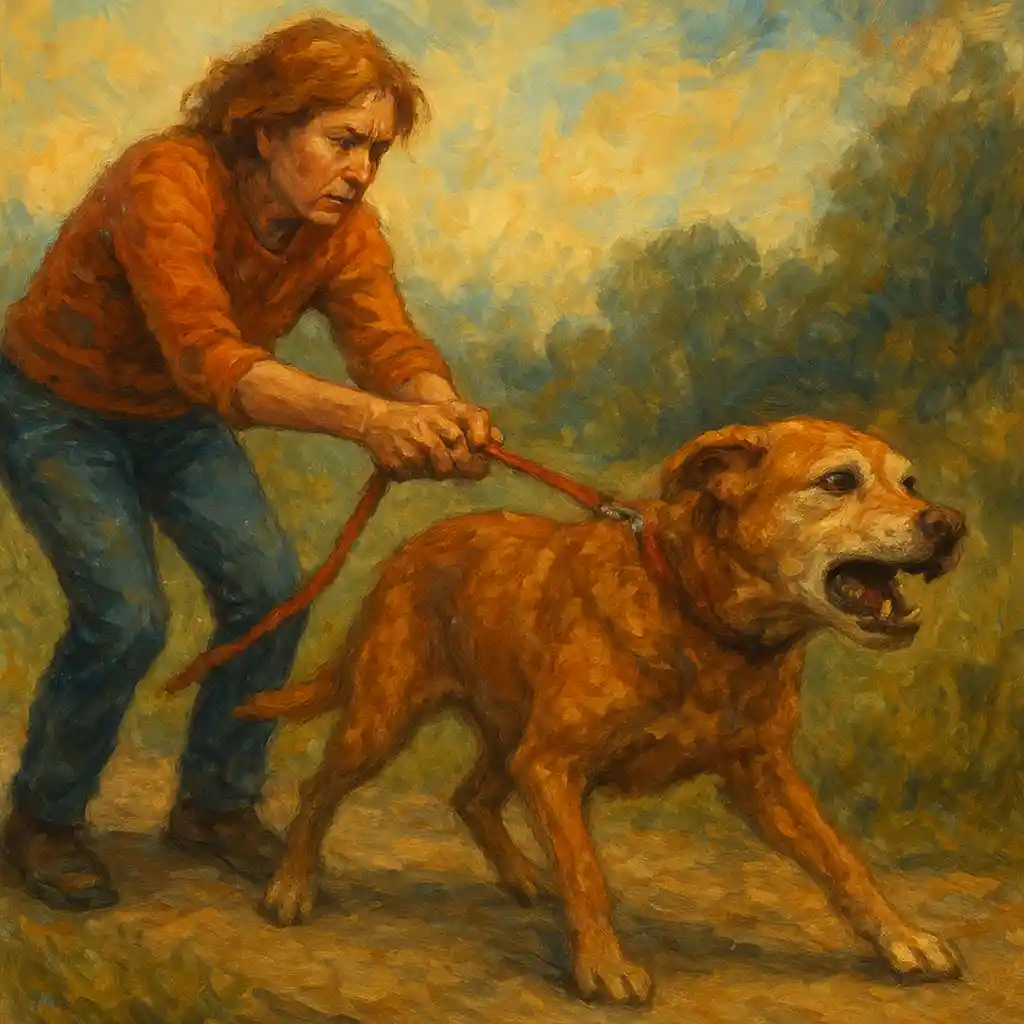
Walking with an older dog can be one of the best parts of the day. Senior dogs often enjoy calm routines, familiar streets, and steady companionship. At the same time, aging can bring new challenges. One common problem is Senior Dog’s Leash Aggression—barking, growling, lunging, or snapping at people while on leash.
This behavior can feel upsetting and hard to handle, especially when it appears “out of nowhere” in a dog who used to be relaxed. The good news is that many senior dogs improve with the right plan. Progress comes from safety first, clear training steps, and a pace that matches an older dog’s body and mind.
What “Leash Aggression” Really Means (and What It Is Not)
Senior Dog’s Leash Aggression is usually a reaction that happens on leash. It often looks like anger, but in many cases it is based on:
- fear or worry
- pain or discomfort
- feeling trapped (because the leash stops escape)
- surprise (especially with vision or hearing changes)
- stress from too much stimulation
It is important to know: leash aggression does not automatically mean your dog is “bad,” “dominant,” or “trying to win.” Many dogs react on leash because they do not feel safe, or they cannot create distance the way they would off leash.
Why This Can Start or Get Worse in Senior Dogs
Aging changes a dog’s body and brain. These changes can make normal life feel harder and more intense. Common reasons senior dogs may become reactive toward people include:
1) Pain and body sensitivity
Arthritis, hip pain, dental pain, and spine problems can make a dog less tolerant. When someone comes close, the dog may worry about being touched or bumped.
Useful tip: Pain is one of the most missed causes of Senior Dog’s Leash Aggression.
2) Reduced vision or hearing
If your dog cannot clearly see or hear someone approaching, people may feel sudden and scary. This can lead to barking, lunging, or snapping.
3) Cognitive changes (canine cognitive dysfunction)
Some older dogs become more anxious, confused, or easily startled. New reactivity can be one sign.
4) Past learning and repeated practice
If a dog has reacted many times, the pattern becomes stronger. The dog learns: “When I bark and lunge, the person goes away.” From the dog’s point of view, the behavior works.
5) Tight leashes and stressful handling
A short leash, a tense grip, and a worried owner can raise a dog’s stress. This is very common and very human.
Start Here: Health and Safety First
Before focusing on training, handle the two most important foundations: health and safety.
Step 1: Book a vet check
A good check-up for a senior dog with new or increasing aggression may include:
- joint exam and pain assessment
- dental check
- vision and hearing check
- review of medications
- discussion of anxiety or cognitive decline
If pain is found and treated, training becomes easier and your dog often becomes calmer quickly.
Step 2: Set clear safety rules for walks
Until your dog improves, treat walks like a safety project:
- avoid crowded places
- choose wide sidewalks or open parks
- walk at quiet times (early morning is often best)
- do not allow strangers to approach or pet your dog
- keep distance from people when possible
Safety is not “giving up.” Safety is what allows training to work.
Understanding Triggers and Threshold (Simple but Powerful)
To change Senior Dog’s Leash Aggression, it helps to understand two key ideas:
Trigger
A trigger is what sets your dog off. For aggression toward people, triggers often include:
- people walking directly toward you
- people wearing hats, hoods, uniforms
- people staring at your dog
- people moving fast (joggers, kids running)
- people appearing suddenly from behind a car or corner
Threshold
Your dog’s threshold is the point where your dog stops being able to learn. Under threshold, your dog can notice a person and still stay calm enough to eat, listen, and move with you. Over threshold, your dog reacts.
Training works under threshold. If your dog is already barking and lunging, learning is limited. At that moment, your goal is simple management: increase distance and exit calmly.
Use the Right Walking Equipment (Comfort + Control)
Senior dogs need equipment that protects their body and helps you stay steady.
Helpful gear for Senior Dog’s Leash Aggression
- Front-clip harness (reduces pulling and lowers neck strain)
- Sturdy 6-foot leash (avoid retractable leashes)
- Treat pouch (fast access matters)
- Comfortable walking shoes (for the owner’s safety too)
- Optional: head halter (only with professional guidance, especially for seniors)
What to avoid
- choke chains, prong collars, shock collars These tools can increase pain and fear. For many dogs, they make aggression worse, especially in older dogs with sensitive bodies.
The Core Training Plan: Counter-Conditioning and Desensitization
The most effective, humane approach for Senior Dog’s Leash Aggression is usually:
- desensitization (gentle exposure at a safe distance)
- counter-conditioning (pairing the trigger with something good)
This changes your dog’s emotional response from “danger” to “good things happen.”
Choose rewards that work for senior dogs
Many older dogs do best with soft, smelly treats that are easy to chew:
- small pieces of chicken
- soft training treats
- cheese (tiny amounts)
- wet food in a squeeze tube (great for fast feeding)
If your dog has dietary limits, use the safest option recommended by your vet.
A Simple Counter-Conditioning Exercise (Daily Walk Version)
This exercise is easy to repeat and builds strong results over time.
Goal
Your dog sees a person and expects something good.
Steps
- Start far away from people. Far means your dog can notice the person and still stay calm enough to eat.
- The moment your dog sees the person, calmly say a marker word like “Yes” (or use a clicker).
- Immediately give 3–5 small treats one after another.
- When the person is gone or you create distance, stop feeding treats.
- Repeat many times on every walk.
Why it works
Your dog learns: “Person appears → treats rain from the sky.” Over time, the emotional reaction changes.
Important detail
If your dog refuses treats, the person is too close. Increase distance and try again.
Distance Management: The Fastest Way to Reduce Incidents
Distance is one of the strongest tools for Senior Dog’s Leash Aggression. More distance lowers pressure and gives your dog space to think.
Practical ways to create distance
- cross the street early
- step into a driveway or behind a parked car
- turn and walk the other way (calmly)
- choose wider paths and open areas
- walk during low-traffic times
Distance is not failure. Distance is smart training.
Teach an “Emergency U-Turn” (A Safety Skill That Saves Walks)
An emergency U-turn is a friendly, trained turn that helps you leave quickly without panic.
How to teach it
- At home or in a quiet area, say “Turn” (choose any word).
- Turn your body and move away in a smooth arc.
- Encourage your dog to follow.
- Reward with several treats as you walk away.
Practice until it feels easy. Then use it outside when a person appears too close.
This skill protects your dog’s stress level and helps you stay confident.
Build Focus: Simple Cues That Lower Reactivity
Training does not need to be complicated. A few simple behaviors can reduce Senior Dog’s Leash Aggression by giving your dog a clear job.
Useful cues for walks
- Name response (dog looks at you when you say their name)
- “Let’s go” (move with you)
- Hand target (touch nose to your hand)
- “Find it” (scatter treats on the ground to sniff)
Sniffing is calming for many dogs and is especially helpful for seniors.
The “Find it” method (very practical)
When you see a person at a distance and want extra calm:
- say “Find it”
- toss 5–10 small treats in the grass
- let your dog sniff and eat while the person passes
This reduces staring, lowers tension, and builds positive patterns.
Muzzle Training: Safety Without Shame
For some dogs, muzzle training is the right choice. A muzzle does not mean your dog is “dangerous.” It means you are serious about safety while you train.
Best type for walks
A basket muzzle is usually the best option because your dog can:
- pant
- drink
- take treats (through the gaps)
Cloth muzzles that hold the mouth shut are not suitable for normal walks.
How to introduce a muzzle (gentle plan)
Go slowly and keep sessions short.
- Show the muzzle → treat.
- Dog sniffs muzzle → treat.
- Put treats inside the muzzle so your dog puts their nose in → treat again.
- Hold the straps for one second (no fastening) → treat.
- Fasten for one second → treat, then remove.
- Build up time slowly: 5 seconds, 10 seconds, 30 seconds, 1 minute.
- Add movement: wear muzzle indoors, then in the yard, then on short walks.
A good muzzle plan creates comfort, not conflict.
Handling and Body Language: Small Changes That Matter
Senior dogs often react more when they feel physical pressure or sudden restraint.
Walk with a “soft leash”
- Keep a gentle curve in the leash.
- Avoid constant tight pulling.
- Tight leash pressure can increase stress and make reactions stronger.
Watch early stress signs
Reacting does not start at barking. Many dogs show earlier signs such as:
- freezing or slowing down
- hard staring
- closed mouth, tight face
- ears pinned back
- weight leaning forward
- growling under the breath
When you see these signs, increase distance early. Early action prevents explosions.
Social Stress: Reduce the “Load” on Your Senior Dog
Senior dogs have less energy for stress. Many do better with a calmer lifestyle while training.
Helpful adjustments
- shorter walks, more often
- quiet routes
- fewer greetings with strangers
- avoid busy pet stores and crowded parks
- more sniff time and rest time
For older dogs, recovery matters. A long, stressful walk can create reactivity for the rest of the day.
A Weekly Training Routine (Simple and Realistic)
Consistency beats intensity. This routine is senior-dog friendly and easy to follow.
Week structure (example)
3–5 days per week: training walks (10–25 minutes) 2–4 days per week: decompression walks (quiet sniff walks, minimal triggers)
Training walk outline
- Start in a calm area. Reward check-ins.
- When a person appears far away: marker word → treats.
- Use “Find it” if needed to keep your dog relaxed.
- If a person appears too close: emergency U-turn.
- End the walk before your dog is exhausted or stressed.
Short, positive walks create faster progress than long, difficult ones.
Common Mistakes (and Better Options)
Reducing Senior Dog’s Leash Aggression often means replacing normal habits with better ones.
Mistake 1: Forcing greetings
Better: Skip greetings. Train neutrality first. Calm passing is a success.
Mistake 2: Punishing growling
Growling is communication. If growling is punished, dogs may skip the warning and bite faster. Better: Increase distance and train under threshold.
Mistake 3: Waiting until the reaction happens
Better: Act early. Cross the street, turn, feed treats when the trigger appears.
Mistake 4: Training when your dog is in pain
Better: Treat pain first, then train. Comfort supports learning.
Mistake 5: Doing too much too soon
Better: Choose small steps. A senior dog improves best with a gentle pace.
When to Get Professional Help
Some situations need expert support. Professional help is a strong and responsible choice.
Work with a qualified trainer or behavior professional if:
- your dog has bitten or attempted to bite
- the aggression is intense or unpredictable
- your dog cannot eat or focus outdoors at any distance
- you feel physically unsafe handling your dog
- the behavior is getting worse
Look for credentials such as:
- IAABC (behavior consultant)
- CCPDT (certified trainer)
- a veterinary behaviorist (DACVB) for complex cases
A professional can also build a plan that fits an older dog’s health limits.
Progress Tracking: A Calm Way to See Improvement
Training can feel slow day to day, but tracking helps you notice real change.
Simple tracking method
After each walk, note:
- the closest distance to a person with no reaction
- the number of reactions (barking/lunging)
- your dog’s ability to take treats (yes/no)
Progress often looks like:
- fewer reactions
- faster recovery after seeing a person
- ability to stay calm at closer distances
- more sniffing and relaxed body language
Even small wins matter. They build the path to big change.
Special Tips for Senior Dogs (Comfort and Kindness)
Senior dogs often need training that protects their body and reduces stress.
Keep sessions short
Older dogs tire faster. Short sessions prevent frustration and pain flare-ups.
Use warm-up time
Let your dog sniff and move gently for a few minutes before expecting focus.
Choose softer surfaces when possible
Grass and dirt paths can feel better than hard pavement for arthritic joints.
Support with enrichment at home
Mental activity reduces stress and improves behavior outside. Good senior-friendly enrichment includes:
- snuffle mats
- food puzzles
- scatter feeding in the yard
- gentle trick training indoors
Calmer days often create calmer walks.
What Success Looks Like (Realistic Goals)
With Senior Dog’s Leash Aggression, the best goal is often not “my dog loves everyone.” A strong and realistic goal is:
- calm passing
- safe handling
- predictable routines
- fewer reactions
- faster recovery
Many senior dogs reach a point where walks feel peaceful again, even if they never become social with strangers. Neutral and safe is a great outcome.
Final Thoughts: A Safe, Steady Path Forward
Senior Dog’s Leash Aggression can feel heavy, but it is often manageable with the right steps. Start with health support, build safety into every walk, and train with calm repetition. Distance management prevents setbacks. Counter-conditioning changes emotions over time. Muzzle training, when needed, adds safety and peace of mind without harming trust.
A senior dog does not need perfect behavior to deserve enjoyable walks. With structure, patience, and kind training, daily life can become calmer and more predictable for both of you. Consistency turns small improvements into lasting change, one walk at a time.