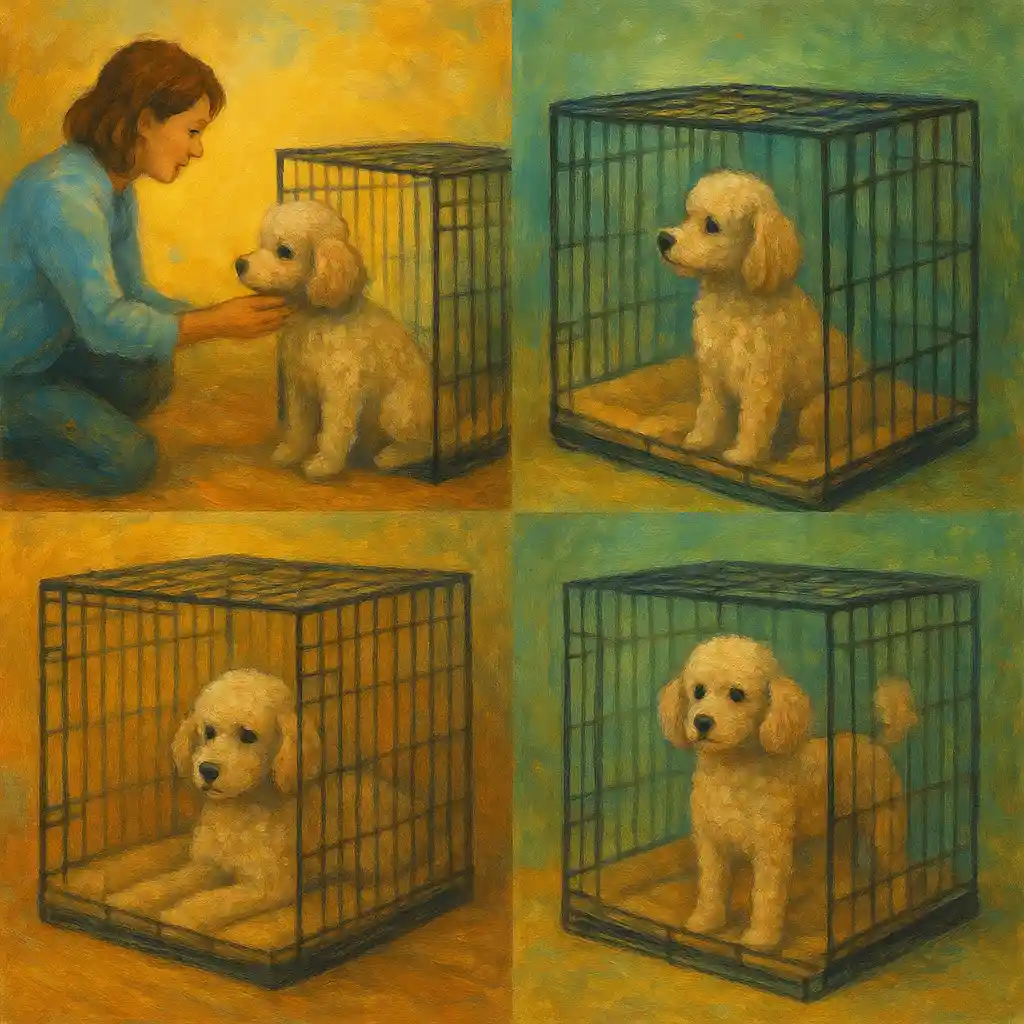
Sensitive Poodles are wonderful companions. They are smart, gentle, and deeply connected to their people. They also notice everything. A new sound, a new smell, a change in routine, guests in the house, or being alone for a short time can feel like a big event.
When a sensitive Poodle feels unsure, the stress can show in many ways. Some dogs pace. Some bark. Some follow their person from room to room. Some chew furniture, scratch doors, or have accidents indoors. These behaviors are not “bad.” They are signs of worry, over-excitement, or confusion.
A well-trained crate can help a sensitive Poodle feel safe. It becomes a calm place where nothing is expected from them. It is a quiet “den” where they can rest, recover, and feel protected. For many dogs, the crate becomes a comfort tool for life, especially during travel, vet visits, storms, fireworks, busy family gatherings, and changes in routine.
This guide offers a clear, positive 5-day crate training plan. It is designed for sensitive Poodles and for owners who want a gentle, step-by-step method that avoids pressure. The goal is not to “make the dog stay in the crate.” The goal is to build trust, comfort, and confidence.
What crate training is, and what it is not
Crate training works best when everyone understands the purpose.
Crate training is
- A way to create a safe, calm resting space
- A tool for building independence in a gentle way
- A support for house training and daily routines
- A management tool that prevents unsafe chewing and stress behaviors
- A comfort “home base” during travel, visitors, or noisy events
Crate training is not
- A punishment
- A place where a dog is left for very long hours
- A solution that replaces exercise, companionship, or training
- A good plan for a dog who panics in confinement without professional help
A sensitive Poodle needs the crate to feel like a choice, not a trap. The training plan below builds that feeling step by step.
Understanding the sensitive Poodle mind
Poodles often learn quickly. A sensitive Poodle learns quickly too, but emotions can get in the way. Many sensitive dogs show these traits:
- Strong attachment to their person
- High awareness of small changes in the home
- Quick startle response to noises
- Faster stress build-up during busy days
- Big feelings that show as barking, whining, or pacing
A calm crate routine helps the nervous system settle. It gives the dog a predictable place to relax, even when life feels busy.
Step zero: prepare for success before day 1
Before starting the 5-day plan, set up the crate and the environment. Good preparation prevents most problems.
1) Choose a crate that fits your Poodle’s size
A crate should feel cozy, not crowded. Your Poodle should be able to:
- Stand up without hitting the top
- Turn around easily
- Lie down stretched out comfortably
A crate that is too large can slow house training and can feel less secure for some sensitive dogs. A crate that is too small can create stress and discomfort.
A simple measuring method
- Measure your dog from nose to base of tail. Add 5 to 10 cm, or 2 to 4 inches.
- Measure from floor to top of head when standing. Add 5 to 10 cm, or 2 to 4 inches.
Use these numbers to choose crate size.
Common crate size ranges for Poodles
These are general starting points. Individual dogs vary.
- Toy Poodle: often 24-inch crate
- Miniature Poodle: often 30-inch crate
- Standard Poodle: often 36-inch to 42-inch crate
If a Standard Poodle is tall and long, 42-inch may be the better choice. If unsure, choose the crate that matches your measurements.
2) Pick the crate style that matches your home and your dog
- Wire crate: good airflow, easy to clean, often folds, can use a cover for a den feeling
- Plastic airline-style crate: more enclosed, can feel cozy, good for travel
- Soft crate: only for calm dogs who do not chew or scratch, best after training is strong
For many sensitive Poodles, a wire crate with a light cover can be the most flexible option.
3) Place the crate in a calm, comfortable spot
Choose a location that is:
- Quiet but not isolated
- Away from direct sunlight, heaters, and cold drafts
- Not in the middle of busy foot traffic
- Easy for the dog to enter and exit without stress
Many dogs relax best when the crate is near family life, such as a corner of the living room. For night training, the crate often works best in the bedroom at first.
4) Make the crate inviting, safe, and simple
Add:
- A comfortable mat or bed
- A blanket that smells familiar
- One safe chew or long-lasting treat during training sessions
Avoid:
- Items that can be swallowed
- Toys that break easily
- Loose strings, ribbons, or unsafe stuffing
5) Safety basics before every crate session
- Remove collar tags that can catch on bars
- Check the door latch
- Check the floor for sharp edges
- Ensure good ventilation
- Keep the temperature comfortable
The key rules for a sensitive-dog crate plan
Sensitive Poodles do best with a calm, steady approach.
- Go slowly and build small wins
- Use rewards generously in the beginning
- Keep early sessions short
- Do not force the dog inside
- Do not use the crate as punishment
- End sessions on success, not on struggle
- Consistency matters more than speed
If your dog shows strong stress, return to an easier step. This is not failure. It is smart training.
The 5-day positive crate training plan
This plan is designed to build comfort in layers. Each day has a main goal, simple steps, and small progress markers. Some dogs move faster. Some need more than five days. The timeline is less important than the emotional result.
Day 1: Friendly introduction and free choice
Goal: The crate becomes a place your Poodle can explore without pressure.
Set-up:
- Crate door stays open
- Soft bedding inside
- A few treats ready
Steps:
- Place a few treats just outside the crate. Allow your Poodle to sniff and eat them.
- Toss one treat just inside the crate entrance. Let your dog step in and step out.
- Toss another treat a little deeper inside.
- Praise softly when your dog chooses to go in.
- Let your Poodle leave whenever they want.
Extra tips for sensitive Poodles:
- Sit near the crate but do not block the entrance
- Keep your voice calm and your movements slow
- Do not close the door on day 1
Progress markers:
- Your Poodle steps into the crate to get treats
- Your Poodle pauses inside for a second or two
- Your Poodle shows curiosity instead of avoiding the crate
Good stopping point: Two to five minutes, several times during the day.
Day 2: Mealtime creates a strong positive association
Goal: The crate becomes linked with comfort and good things, especially food.
Food is powerful. For many dogs, it is the fastest way to build a good emotional response.
Set-up:
- Crate door open
- Food bowl and treats ready
- Calm environment
Steps:
- Place the food bowl near the crate entrance. Let your dog eat with the door open.
- For the next meal, place the bowl just inside the crate.
- For the next meal, place it farther back.
- Add a special crate-only item after the meal, such as a stuffed food toy or safe chew.
Important detail: Keep the door open at first. The feeling of control matters for sensitive dogs.
Progress markers:
- Your Poodle walks into the crate willingly for meals
- Your Poodle stays inside to finish eating
- Your Poodle looks relaxed during and after the meal
Good stopping point: The meal itself, plus a few minutes with a chew. Stop before your dog becomes restless.
Day 3: Gentle alone time with short, planned breaks
Goal: Your Poodle learns that being in the crate can happen even when you move around, and that you always come back.
This day is about tiny separations that feel safe.
Set-up:
- A high-value chew or stuffed toy
- Calm background sound if helpful, such as soft music
- Pheromone diffuser can be added in the room for extra support
Steps:
- Ask your dog to go into the crate using a treat lure or simple cue such as “crate.”
- Give the chew inside the crate.
- Close the door gently. Stay nearby.
- Wait 10 to 30 seconds, then open the door before whining starts.
- Repeat several times, slowly increasing to one minute, then two minutes.
- Add small movement. Stand up, sit down, walk to the kitchen, return.
- Keep returns calm. No big greetings. Calm in, calm out.
Progress markers:
- Your Poodle focuses on the chew instead of watching the door
- Your Poodle stays calm while you move briefly out of sight
- Whining decreases or does not appear
If whining happens:
- Wait for a short quiet moment, even one second, then open the door
- Reduce the difficulty next time by shortening the time
This teaches that calm behavior opens doors, not noise.
Day 4: Nighttime crate training with a steady bedtime routine
Goal: The crate becomes a calm sleeping place, not a lonely place.
Night can be difficult for sensitive dogs. Darkness and silence can make them feel unsure. A good plan prevents stress.
Set-up:
- Crate in the bedroom, close enough for your dog to feel your presence
- Comfortable bedding
- Light crate cover if your dog likes a den feeling
- A final potty break before bed
A simple bedtime routine:
- Calm evening walk or gentle play
- Final potty break
- Quiet time, dim lights
- Short treat trail into the crate
- Calm goodnight phrase
- Sleep
Handling nighttime noise:
- Stay calm and quiet
- Avoid talking too much
- If the dog has not pottied for many hours, take a quick potty break with no play
- Return to the crate and keep the routine steady
Progress markers:
- Your Poodle settles faster each night
- Night whining reduces
- Your Poodle sleeps for longer blocks of time
Important: Puppies and small dogs may need more nighttime potty breaks. Adjust the plan to your dog’s age and health.
Day 5: Build confidence and make the crate part of real life
Goal: The crate works during daily routines, not only during training sessions.
On day 5, your dog already has positive experiences. Now you make the crate useful.
Steps:
- Use the crate for short rest times after walks, grooming, or training.
- Give a chew in the crate while you do simple tasks at home.
- Practice short “out of the house” moments. Step outside for one minute, then return calmly.
- Increase the time slowly, such as 1 minute, 3 minutes, 5 minutes, 10 minutes.
- Keep the crate pleasant. Sometimes give treats, sometimes just calm rest.
Teach two helpful words:
- A cue to enter, such as “crate”
- A release cue, such as “free”
This makes crate time clear and predictable.
Progress markers:
- Your Poodle goes into the crate on cue
- Your Poodle rests inside even when you move around
- Your Poodle shows relaxed body language in the crate
By the end of day 5, many sensitive Poodles start to see the crate as their own calm room.
After the first five days: how to keep progress strong
Training continues through daily habits. These small choices keep the crate positive.
Keep using rewards sometimes
You do not need treats forever, but surprise rewards keep the crate valuable. A simple pattern works well:
- Treats often during week 1
- Treats sometimes during week 2
- Treats randomly after that
Keep crate time balanced
Crates are for rest, safety, and short management, not for long isolation.
General guidelines for healthy adult dogs often stay around:
- Up to 4 hours during the day when needed
- Longer at night if the dog sleeps well and has had exercise and potty breaks
Puppies, senior dogs, and dogs with medical needs may require shorter periods and more breaks.
Keep the crate as a safe space
Allow your Poodle to use the crate when they want quiet time. Respect that choice. Ask children and visitors not to disturb a dog resting in the crate.
Common crate training mistakes to avoid
Sensitive dogs react strongly to training mistakes. Avoiding these issues saves time and stress.
Using the crate as punishment
If the crate becomes linked to anger or isolation, the dog may fear it. Keep the crate connected to calm and good experiences.
Moving too fast
Long crate sessions too early often cause barking and panic. Short sessions build confidence better.
Letting whining become a successful strategy
Opening the door while whining can teach the dog that noise opens doors. Instead, wait for a quiet moment, then open.
Inconsistent routines
Sensitive Poodles love predictability. Feeding, potty breaks, and crate time work best with a steady rhythm.
Leaving a dog in the crate too long
A dog that has no chance to stretch, potty, or interact can develop stress. Use the crate as part of a full daily plan that includes walks, play, and connection.
Ignoring signs of stress
Common stress signs include:
- Heavy panting when the room is not hot
- Drooling
- Scratching or biting the crate
- Wide eyes, pinned ears
- Shaking, pacing, or frantic movement
When these appear, reduce difficulty and return to easier steps.
Safety tips for crate training sensitive Poodles
Safety supports calm. A safe crate is a relaxing crate.
Temperature and ventilation
- Keep the crate away from direct sun
- Avoid placing it near heaters
- Ensure airflow
- In hot weather, use fans safely and offer cool water outside crate time
Secure and escape-proof
- Check latches daily
- Look for bent wires or broken parts
- Use a sturdy crate for strong or clever dogs
Remove hazards
- Remove collars with tags when crating
- Avoid bones that splinter
- Choose chews that match your dog’s chewing style
- Avoid long strings, ribbons, and fragile toys
Clean and check the crate often
- Clean accidents with an enzyme cleaner
- Wash bedding regularly
- Check for loose screws or sharp edges
Troubleshooting: solutions for common challenges
Even with a good plan, challenges happen. These fixes keep training positive.
Challenge 1: The dog refuses to enter the crate
Likely cause: The crate feels new, uncertain, or too confined. Helpful steps:
- Return to day 1 style training with the door open
- Use higher value treats
- Feed near the crate again
- Place treats inside and allow free choice
- Add a crate cover if your dog likes a den feel
Challenge 2: Whining starts as soon as the door closes
Likely cause: The step is too hard. Helpful steps:
- Close the door for one second, then open
- Build up in tiny increments
- Give a chew only when the door closes, so the door predicts good things
- Stay nearby at first
Challenge 3: Barking or panic when left alone
Likely cause: Separation anxiety may be present, or the dog has not learned gradual alone time. Helpful steps:
- Practice very short departures with planned success
- Keep returns calm and boring
- Use calming music and a steady routine
- Increase exercise and mental enrichment before crate time
If panic is intense, professional support is the kindest and fastest path.
Challenge 4: Accidents in the crate
Likely cause: Too much time in the crate, crate too large, or potty schedule needs adjustment. Helpful steps:
- Shorten crate sessions
- Increase potty breaks
- Clean with enzyme cleaner to remove smell
- Check crate size and add a divider if needed
- Consider a vet check if accidents are new or unusual
Challenge 5: Chewing bars or scratching the crate
Likely cause: Stress, boredom, or too much energy. Helpful steps:
- Provide more exercise before crating
- Use a safe chew to occupy the mouth
- Reduce crate time length
- Consider a more den-like crate set-up with a cover
- Return to shorter sessions to rebuild calm
Challenge 6: Nighttime restlessness
Likely cause: Needs potty, too much evening energy, or crate location feels too far away. Helpful steps:
- Add a calm bedtime routine
- Ensure a final potty break
- Move the crate closer to the bed
- Keep the room calm and dark
- Avoid exciting play at bedtime
When professional help is the right next step
Some dogs need more support than a home plan can provide. Professional help is appropriate when a dog:
- Panics in the crate
- Tries to injure themselves to escape
- Shows extreme drooling, shaking, or frantic behavior
- Has strong separation anxiety signs that do not improve with gradual training
A certified positive reinforcement trainer or a veterinary behaviorist can create a safe plan, sometimes with medical support if needed. This is not a failure. It is responsible care.
Final thoughts: a crate can become your Poodle’s comfort tool for life
A sensitive Poodle needs safety, predictability, and kindness. A positive crate training plan offers all three. In five days, the goal is not perfection. The goal is trust. With small steps, steady routines, and gentle rewards, many Poodles learn that the crate is a calm place where they can rest and feel secure.
Keep sessions short, celebrate small progress, and protect the crate’s positive meaning. Over time, the crate becomes more than a training tool. It becomes a quiet home base where your Poodle can breathe, relax, and feel safe, even when the world feels busy.