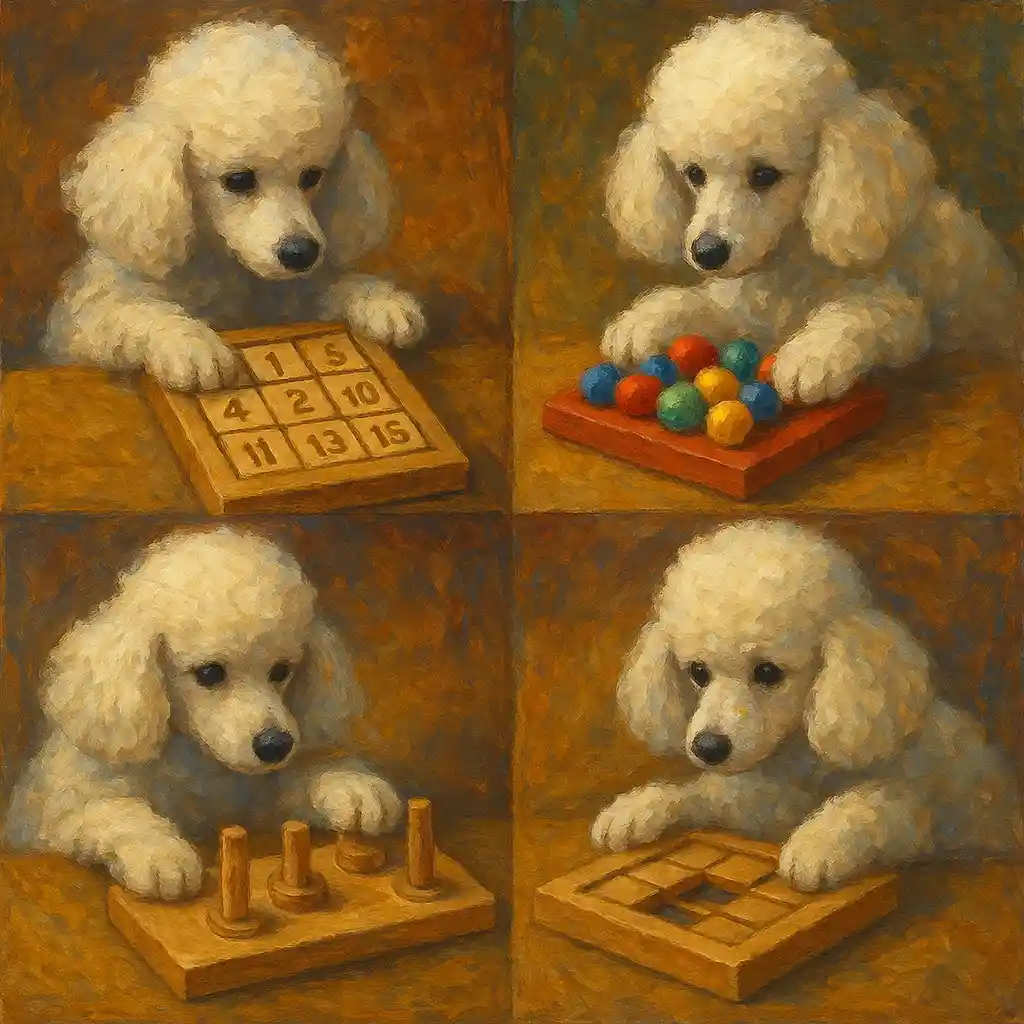
A bored Poodle can turn a quiet home into a noisy, messy place. Chewed pillows, stolen socks, endless barking, and “creative” interior design with shredded paper often come from the same problem: a smart dog with nothing to do.
Poodles are not only cute and sporty. They are also very intelligent. They learn quickly, remember patterns, and notice small changes in daily life. This is wonderful, but it also means they need regular mental exercise. A long walk helps the body, but the brain also needs work. When the brain is busy, many behavior problems become smaller. A mentally satisfied Poodle usually rests better, barks less, and listens more.
This blog entry gives clear, practical games that build focus, confidence, and calm energy. It also shows a simple rotation system, so your Poodle does not get bored with the same activity. Everything is designed to be easy to start, even for busy owners and older adults who prefer calm, low-impact games.
Why mental stimulation matters for Poodles
Poodles often rank among the most intelligent dog breeds. Many Poodles love learning, solving problems, and working with people. They enjoy activities with rules and rewards. Without this, they can create their own “jobs,” such as guarding the window, barking at every sound, or taking items to chew.
Mental stimulation helps because it:
- Gives the brain a task, not only the body
- Builds self-control, such as waiting, sniffing, and searching calmly
- Reduces stress, especially in dogs that worry or get over-excited
- Improves focus, which supports better training and better walks
- Prevents boredom habits, including barking, chewing, and pacing
Mental work is also very helpful for senior dogs. Older Poodles may walk less, but they still need purpose and fun. Gentle brain games can keep them bright and engaged without stressing joints.
Common signs of boredom in Poodles
Boredom looks different in each dog. Many Poodles show it clearly, especially in the home.
Typical signs include:
- Excess barking, especially at home with no clear trigger
- Destructive chewing, like furniture, shoes, pillows, or cords
- Restlessness, pacing, following people constantly, or difficulty settling
- Attention-seeking behavior, like pawing, nudging, stealing objects
- Over-excitement, jumping and spinning when nothing is happening
- “Busy nose” trouble, such as digging, trash hunting, or counter surfing
These signs do not mean your dog is “bad.” They often mean your dog is under-stimulated, over-energized, or both.
Safety first: simple rules for safe brain games
Mental games should be fun, not risky. A few easy safety habits make a big difference.
1) Supervise at the start
Always supervise when you introduce a new toy or a new game. Some dogs chew hard, swallow pieces, or get frustrated. After you know the game is safe for your dog, you can allow more independent play.
2) Choose the right toy size
Avoid small parts. Toys should be large enough that your Poodle cannot swallow them. If you have a small Toy Poodle, choose toys made for small breeds but still large enough to avoid choking.
3) Check toys often
Inspect toys and feeders for cracks, sharp edges, loose strings, or missing parts. Replace damaged toys quickly.
4) Keep frustration low
A brain game should be challenging but possible. If your Poodle gets stuck, they may bark, scratch, or give up. Help them a little and make the next try easier.
5) Use treats smartly
Use small treats to avoid weight gain. You can also use part of your dog’s daily kibble. Many Poodles work happily for praise, petting, or a short tug game.
6) Adjust for age and health
For senior Poodles or dogs with joint issues, choose more sniffing games and gentle training. Limit jumping and fast turns. If your dog has medical issues, follow your vet’s advice.
The 15 best mental stimulation games for clever Poodles
These games work well for Poodles because they support learning, scent work, self-control, and problem-solving. Use them in short sessions. Five to ten minutes is often enough for real mental work.
To prevent boredom, rotate games. Do not use all 15 in one week. Pick a small mix, then switch next week.
1) Hide and Seek (people version)
Goal: Focus, recall, and fun bonding Best for: Indoor play, rainy days
How to play
- Ask your Poodle to stay with a family member, or use a baby gate.
- Hide in an easy place at first.
- Call your dog once in a happy voice.
- Reward when they find you with praise and a treat.
Make it harder
- Hide in a different room
- Hide behind a door or curtain
- Add two people hiding and taking turns
Safety tip Avoid tight spaces where your dog could get stuck.
2) Hide and Seek (treat version)
Goal: Scent work and calm searching Best for: Dogs that bark from boredom
How to play
- Show your dog a treat.
- Ask them to wait briefly.
- Place treats in easy places, like corners or near chair legs.
- Say a cue such as “Find it.”
- Let them sniff and search.
Make it harder
- Hide treats higher but still safe, like on a low shelf
- Use fewer treats and increase distance
- Hide one special treat and make it the “final prize”
Safety tip Avoid hiding food where your dog might jump unsafely.
3) Interactive puzzle toys
Goal: Problem-solving and persistence Best for: Independent play with supervision
How to use
- Start with a simple level puzzle
- Put soft treats or kibble inside
- Let your Poodle explore
- Help once or twice so they learn the idea
Make it harder
- Increase puzzle difficulty slowly
- Use smaller treats that require more work
- Mix easy and hard compartments
Safety tip Choose sturdy puzzles and watch for chewing on plastic parts.
4) Treat-dispensing ball or rolling toy
Goal: Brain work plus light movement Best for: High-energy Poodles
How to play
- Fill the toy with kibble.
- Show your dog how it moves.
- Let them roll and nudge it to release food.
Make it harder
- Use less food, so rewards are slower
- Use a toy with adjustable holes
- Play in a larger space so the toy moves more
Safety tip Use on a safe surface where your dog does not slip.
5) DIY snuffle mat
Goal: Natural sniffing and calm behavior Best for: All ages, including seniors
Easy DIY idea
- Use a rubber sink mat with holes
- Tie fleece strips through the holes
- Sprinkle kibble and small treats inside the fleece “grass”
How to play
- Place the mat on the floor
- Say “Find it”
- Let your Poodle sniff slowly and search
Make it harder
- Hide food deeper in the fleece
- Use fewer pieces
- Add a second mat in another room
Safety tip Supervise dogs that chew fabric.
6) Frozen Kong-style toy
Goal: Long-lasting calming activity Best for: Alone time, crate time, quiet evenings
Simple filling ideas
- Wet kibble, then freeze
- Plain yogurt with banana (small amount)
- Pumpkin puree (dog-safe)
- A few treats sealed with a bit of wet food
How to use
- Give the frozen toy in a washable area
- Allow quiet licking and chewing
- Remove when it becomes small enough to swallow
Make it harder Freeze in layers so your dog works longer.
Safety tip Avoid xylitol and other unsafe sweeteners. Choose dog-safe ingredients only.
7) Mini agility course at home
Goal: Body awareness, focus, confidence Best for: Active, healthy adult Poodles
Simple home setup
- Walk around cones made from cups
- Step over a broomstick on the floor
- Go under a chair tunnel
- Pause on a mat as a “finish line”
How to play
- Use treats to guide
- Keep it slow and controlled
- Reward calm steps, not only speed
Make it easier Start with one obstacle at a time.
Safety tip Avoid jumping for senior dogs or dogs with joint problems.
8) Short obedience and trick training
Goal: Strong communication and impulse control Best for: Daily routine and polite manners
Good training ideas
- Sit, down, stay
- Touch a hand target
- Spin, paw, bow
- Go to mat and relax
- Carry a toy to a box
How to train
- Use short sessions, 3 to 7 minutes
- Reward fast at first
- End with an easy win
Make it harder Add mild distractions, like training in another room.
Safety tip Keep sessions fun. Avoid repeating commands many times.
9) Scent boxes
Goal: Real nose work at home Best for: Clever dogs that need calm focus
What you need
- 3 to 6 small boxes or containers
- Treats
How to play
- Place a treat in one box while your dog watches.
- Put the boxes on the floor.
- Say “Find it.”
- Reward when they choose the correct box.
Make it harder
- Hide the treat without your dog watching
- Add more boxes
- Use empty boxes with a tiny treat scent only
Safety tip Use boxes that cannot cut the mouth, and remove tape or staples.
10) Scent trail
Goal: Controlled searching, low-impact exercise Best for: Seniors and rainy-day indoor play
How to play
- Drag a treat lightly on the floor to create a short trail.
- Place the treat at the end.
- Bring your dog to the start point.
- Say “Track” or “Find it.”
- Let them follow slowly.
Make it harder Create turns, longer trails, or trails across rooms.
Safety tip Use a safe floor to prevent slipping.
11) Fetch with a twist
Goal: Listening skills and brain work, not only running Best for: Dogs that love fetch
Twist ideas
- Fetch and return to a specific target, like a mat
- Fetch only on a cue, not on excitement
- Teach toy names, like “ball” and “rope,” then ask for the right one
- Hide the ball and ask your dog to search before fetching
Make it harder Ask for a sit before each throw.
Safety tip Limit repetitive hard throwing if your dog gets over-excited.
12) Tug-of-war with rules
Goal: Controlled excitement and strong bond Best for: Dogs that enjoy play with people
Rules that keep it polite
- The game starts only on a cue like “Tug”
- The game stops on a cue like “Drop”
- Reward dropping with a treat or a restart
- Keep tug low, not up in the air
Make it harder Add short “drop and wait” moments before restarting.
Safety tip Avoid tugging with puppies that are still growing hard, and avoid twisting too strongly.
13) Brain teaser: muffin tin game
Goal: Problem-solving with simple tools Best for: Indoor play, low cost
What you need
- A muffin tin
- Tennis balls or safe balls that cover holes
- Treats or kibble
How to play
- Put food in some holes.
- Cover holes with balls.
- Let your Poodle remove balls to find food.
Make it harder Cover all holes but only put food in some. Your dog must search longer.
Safety tip Use balls too large to swallow.
14) The shell game (cup shuffle)
Goal: Focus and memory Best for: Dogs that enjoy watching your hands
What you need
- 3 cups or bowls
- Small treats
How to play
- Place a treat under one cup while your dog watches.
- Shuffle slowly once or twice.
- Allow your dog to indicate the cup with nose or paw.
- Lift the correct cup and reward.
Make it harder Shuffle more, or use more cups.
Safety tip Avoid glass. Use stable cups that do not break.
15) Water play and “search in water”
Goal: Enrichment and cooling, gentle resistance exercise Best for: Many Poodles, especially in warm weather
Simple safe water games
- Splash in a shallow kiddie pool
- Find floating toys
- Search for treats in a shallow tray of water
- Follow a floating toy to the edge and bring it back
Make it easier Start with very shallow water and calm praise.
Safety tip Supervise closely. Use a dog life jacket near deeper water. Stop if your dog shows stress.
The toy rotation system that makes games work long-term
Even the best toy becomes boring when it is always available. Rotation keeps “old” toys exciting again.
Simple rotation method
- Keep 4 to 6 toys available for the week
- Store the rest in a closed box
- Swap the set once a week
- Wash toys when needed, especially food toys
This system helps because your Poodle feels the toy is new again. It also reduces clutter and makes it easier to choose a daily activity.
A weekly game rotation schedule that stays realistic
A good routine uses short sessions. Many Poodles do well with:
- Two short sessions per day, 5 to 10 minutes each
- One longer session on a weekend day, 15 to 25 minutes
- One calm chewing or licking activity several times per week
Below is a sample schedule. Adjust it to your home and your dog’s energy.
Sample Week Plan
Monday
- Morning: Snuffle mat
- Evening: Short trick training
Tuesday
- Morning: Treat-dispensing ball
- Evening: Tug-of-war with rules
Wednesday
- Morning: Scent boxes
- Evening: Frozen Kong-style toy
Thursday
- Morning: Hide and seek with treats
- Evening: Muffin tin game
Friday
- Morning: Fetch with a twist
- Evening: “Go to mat” training for calm settling
Saturday
- Longer session: Mini agility course, slow and controlled
- Calm finish: Licking toy or chew
Sunday
- Easy day: Scent trail indoors
- Toy rotation: Swap toys for the next week
This plan mixes sniffing, thinking, training, and movement. It also includes calm activities, not only exciting ones.
Tips that keep Poodles engaged without overstimulating them
Keep games short and successful
Stop while your dog still wants more. This keeps motivation high.
Increase difficulty slowly
A small change is enough. Examples include:
- hiding treats a little better
- adding one more box
- asking for a sit before starting
Reward calm behavior, not only speed
Poodles learn quickly. Rewarding calm searching and gentle problem-solving builds a calmer dog over time.
Use meals as enrichment
Many games can use kibble instead of extra treats. This helps weight control and keeps motivation strong.
Offer choice
Some days your dog will prefer sniffing games. Other days they will prefer tug or training. Rotating games naturally covers this.
Support older dogs with gentle options
For senior Poodles, choose:
- snuffle mat
- scent trail
- scent boxes
- cup game
- simple training
- frozen licking toys
These give real mental work without heavy impact.
Reducing boredom barking with mental stimulation
Barking often becomes a habit when it works for the dog. A bored Poodle may bark because it brings attention, releases energy, or “controls” the environment.
A practical plan focuses on three parts.
1) Meet needs before the barking starts
A short sniffing game in the morning often prevents barking later. A frozen food toy during quiet time can help your Poodle settle.
2) Redirect to a clear job
Instead of letting your dog practice barking, offer a task:
- “Find it” with a few pieces of kibble
- “Go to mat” with a chew
- A short training session with easy cues
Over time, the dog learns that calm behavior brings rewards and activities.
3) Improve the environment
Simple changes reduce barking triggers:
- Close curtains if window guarding is a problem
- Use a white noise machine for outside sounds
- Provide a safe chew zone away from the front door
- Add predictable rest times during the day
If barking is intense, sudden, or linked to fear, professional help from a qualified trainer or behaviorist can make progress faster and safer.
Real-life results: what changes with a simple game routine
Many Poodle owners notice similar improvements after two to four weeks of regular mental games.
Example 1: A young Poodle that chewed furniture The dog received two short enrichment sessions daily, plus a frozen food toy in the evening. Chewing moved from furniture to safe chews, and the dog began resting after meals instead of searching for trouble.
Example 2: A middle-aged Poodle that barked at sounds Scent games and “go to mat” training were added. The dog learned a calmer daily rhythm. Barking reduced because the dog had a better job and more rest.
Example 3: A senior Poodle that seemed restless at night A gentle scent trail and a short cup game were added in the late afternoon. The dog showed calmer evening behavior, likely from healthy mental tiredness without hard exercise.
These improvements come from consistency, not perfection. Small daily steps create big behavior changes over time.
Conclusion: a smarter routine for a smarter dog
A clever Poodle needs more than basic walks and a basket of toys. Mental stimulation gives purpose, reduces boredom habits, and supports calm behavior at home. With a simple rotation of brain games, your dog stays interested, engaged, and easier to live with.
Use the 15 games in this post as a toolbox. Pick a few favorites, keep sessions short, rotate weekly, and focus on calm success. Over time, a mentally satisfied Poodle becomes a happier companion with fewer problems and more good moments every day.