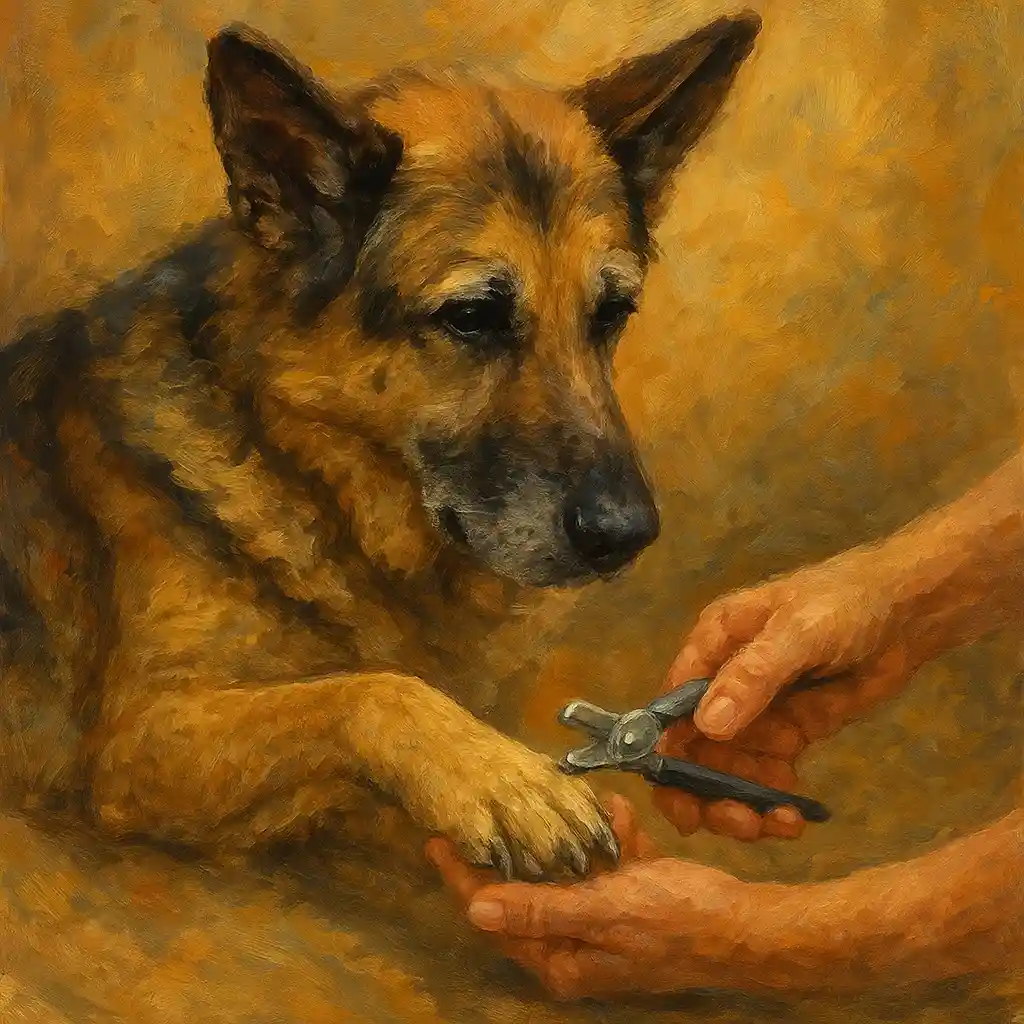
Nail care becomes more important as a German Shepherd gets older. Senior dogs often have stiffer joints, less natural nail wear, and less patience for long grooming sessions. Long nails can change how a dog stands and walks. Over time, this can add pressure to the toes, wrists, elbows, shoulders, hips, and spine. For a senior German Shepherd, that extra pressure can mean more pain and less mobility.
This guide is a practical plan for Nail Trimming for Senior German Shepherds. It covers comfort, safety, tool choice, a full desensitization program, trimming frequency, step-by-step trimming with clippers or a grinder, and what to do when things go wrong.
Regular Nail Trimming for Senior German Shepherds can prevent painful issues.
Nail Trimming for Senior German Shepherds not only helps avoid pain but also supports mobility.
Why nail trimming matters more in senior German Shepherds
German Shepherds are large, athletic dogs. In old age, they often deal with arthritis, weaker muscles, and balance changes. Nails that are too long can make all of that harder.
Problems caused by overgrown nails
- Pain when walking: The nail presses back into the nail bed, and the toes spread in an unnatural way.
- Less grip on floors: Seniors already slip more easily. Long nails reduce traction even more.
- Joint stress: Long nails can shift posture and load joints in the wrong way.
- Broken nails: Overlong nails catch on rugs, stairs, and grass. Breaks are painful and bleed a lot.
- Infections: Cracks or breaks can let bacteria in.
- Harder trimming later: When nails stay long, the quick (the living tissue inside the nail) often grows longer too, making safe trimming more difficult.
A simple routine helps your dog stay comfortable, stable, and active for longer.
Understanding nail-trim stress in older German Shepherds
Implementing a routine for Nail Trimming for Senior German Shepherds ensures their nails remain healthy.
Many senior German Shepherds dislike nail trimming, even if they were fine when young. This happens for clear reasons.
Knowing the importance of Nail Trimming for Senior German Shepherds can help alleviate anxiety.
Common reasons seniors resist nail trimming
- Pain from arthritis: Holding a paw up can hurt shoulders, elbows, wrists, hips, or the spine.
- Past bad experience: One quick cut or one scary session can create lasting fear.
- Sensitivity changes: Older dogs may be more sensitive to sound, vibration, or touch.
- Less balance: Seniors can feel unsafe standing on three legs.
- Handler tension: Dogs notice breathing changes, tight hands, and rushed movements.
The goal is not to “win” a struggle. The goal is to build trust and make trimming predictable and safe.
The best mindset for success
For Nail Trimming for Senior German Shepherds, progress comes from small steps.
Keep these rules:
- Keep sessions short.
- Stop while your dog is still calm.
- Reward calm behavior, not only perfect behavior.
- Choose a setup that reduces pain and slipping.
- Aim for steady improvement, not a perfect trim on day one.
Tools and supplies for stress-free nail trimming
Understanding Nail Trimming for Senior German Shepherds can enhance their grooming experience.
Having the right supplies prevents accidents and makes sessions faster.
Establishing a calm environment for Nail Trimming for Senior German Shepherds is crucial.
Essential items
- Non-slip mat or yoga mat
- Good lighting (lamp or bright overhead light)
- Treats in small pieces (soft treats work well)
- Nail tool: quality clippers or a grinder
- Styptic powder or styptic pencil (to stop bleeding)
- Cotton pads or clean towel
- Nail file (optional, for smoothing)
- A comfortable resting spot (bed or folded blanket)
Helpful extras
- Headlamp for better visibility
- Peanut butter lick mat to keep attention steady
- Muzzle training (only if needed and introduced gently)
- A helper (calm, experienced, not forceful)
Clippers vs grinder for senior German Shepherd nails
Both can work well. Your choice depends on your dog’s comfort and your own skill.
Clippers: pros and cons
Seek advice on Nail Trimming for Senior German Shepherds to avoid common mistakes.
Pros
- Fast and quiet
- No vibration
- Good for dogs who dislike the grinder sound
Cons
Tools are essential for effective Nail Trimming for Senior German Shepherds.
- Higher risk of cutting the quick if you trim too much
- Can crush thick nails if the clippers are low quality or dull
- Leaves a sharper edge unless you smooth it
Clippers are often best for calm dogs and owners who can see what they are doing clearly.
Grinder: pros and cons
Pros
- Lower risk of quick injury when used slowly
- Great control on thick nails
- Smooth finish, less snagging
- Helps “walk back” the quick over time with frequent small trims
Cons
- Noise and vibration can scare some dogs
- Takes longer per nail
- Can heat the nail if you grind too long in one spot
A grinder is often best for black nails (where the quick is hard to see) and for owners who prefer gradual changes.
Practical recommendation
Many owners succeed with a mixed method:
- Use clippers to remove a small amount quickly
- Use a grinder to shape and smooth
This reduces session time and improves comfort.
Choosing the right tool for your dog and your hands
For Nail Trimming for Senior German Shepherds, comfort matters on both ends.
Choose based on your dog
- Noise-sensitive dogs often prefer quiet clippers
- Dogs who panic when they feel pressure on the nail often do better with a grinder
- Very thick nails often become easier with a grinder or heavy-duty clippers
Choose based on your ability
- If you feel unsure, start with a grinder and do tiny amounts
- If your hands shake or you have weaker grip, a grinder can be easier than squeezing clippers
- If you struggle to see well, use brighter light and consider a grinder for gradual trimming
Nail trimming frequency for senior German Shepherds
A common target is every 2–4 weeks, but many seniors do best with smaller, more frequent sessions.
Simple guidelines
- Every 1–2 weeks: best for dogs whose quick is long, or dogs with very fast nail growth
- Every 2–4 weeks: typical maintenance range
- Every 4–6 weeks: only if nails wear down naturally and stay short
Clear signs nails are too long
- Nails click on hard floors
- Your dog’s toes look pushed forward or splayed
- Nails curve toward the ground
- Your dog slips more, especially on smooth floors
- You see cracks, splitting, or rough edges
For seniors, do not wait for nails to get very long. Small, regular trims are safer and less stressful.
A complete desensitization plan that works
Desensitization means helping your dog feel safe with tiny steps. This is the core of calm Nail Trimming for Senior German Shepherds.
Key rules
- Work below your dog’s fear level
- Use high-value rewards
- Keep sessions under 1–5 minutes at first
- End on a success
Stage 1: Calm paw touch (3–7 days or longer)
Goal: Your dog stays relaxed when paws are handled.
Steps:
- Touch shoulder, then leg, then paw for one second.
- Reward immediately.
- Stop and repeat later.
Increase slowly:
- Hold the paw for 2 seconds, reward.
- Press lightly on one toe, reward.
- Touch nails with your finger, reward.
If your dog pulls away, reduce difficulty and shorten the hold.
Stage 2: Introduce the tool without using it (3–7 days)
Goal: Tool predicts good things.
Steps:
- Show clippers or grinder for one second.
- Reward.
- Put tool away.
Repeat until your dog looks calm when the tool appears.
Stage 3: Add sound (mainly for grinders) (3–14 days)
Remember, Nail Trimming for Senior German Shepherds is a gradual process that takes time.
Goal: Sound becomes normal.
Steps:
- Turn the grinder on far away for one second.
- Reward.
- Turn it off.
Slowly reduce distance over sessions. Later, turn it on near your dog’s shoulder, not near the paw yet.
For clippers:
- Practice the “snip” motion in the air
- Reward calm behavior
Stage 4: Combine paw handling + tool presence (as long as needed)
Goal: Your dog accepts paw hold while the tool is nearby.
Steps:
- Hold paw, bring tool near, reward, release.
- Keep it short and easy.
Stage 5: One nail only (the breakthrough stage)
Goal: One nail done calmly.
Steps:
- Do one nail, then stop.
- Reward well.
- End the session.
Over time, build up to two nails, then three. For many seniors, a “few nails per day” plan is better than a full set all at once.
A regular schedule for Nail Trimming for Senior German Shepherds can lead to better health.
Setting up a calm nail trimming environment
A good setup prevents slipping, reduces pain, and improves trust.
Best environment choices
- Quiet room, no sudden visitors
- Non-slip mat under your dog
- Your dog can lie down if needed
- Bright light aimed at the paws
Signs that your dog needs Nail Trimming for Senior German Shepherds can help maintain their comfort.
Watching for signs of discomfort during Nail Trimming for Senior German Shepherds is important.
Best body positions for senior German Shepherds
- Side-lying position: dog lies on one side, you lift one paw gently
- Chest-down position: dog lies on belly, you work on front paws first
- Avoid forcing a standing “show dog” stance if balance is weak
If your dog has arthritis, handle each limb carefully and avoid bending joints too far.
Nail anatomy in simple terms
Knowing where the quick is keeps trimming safe.
- The nail is the hard outer shell.
- The quick is the living inner part with blood vessels and nerves.
If you cut the quick, it bleeds and hurts. On light nails, the quick is often visible as a pink area. On black nails, you often cannot see it.
Helpful tip for black nails
Trim tiny amounts. After each small trim, look at the cut end:
- Chalky, dry center means you are still far from the quick
- Darker, softer center means you are getting closer
- A small shiny or moist dot can mean “stop soon”
Step-by-step: Using clippers safely
This method is fast and quiet.
Step 1: Prepare
- Treats ready
- Styptic powder nearby
- Dog on non-slip mat
- Calm handling and slow breathing
Step 2: Hold the paw gently
Support the paw, do not twist it. For seniors, keep the leg in a natural position.
Step 3: Choose the cutting angle
Trim small slices from the tip. Avoid cutting straight across in a big chunk.
Step 4: Trim tiny amounts
For maintenance:
- Remove a thin slice
- Pause
- Reward
If nails are long, do not try to shorten them to “perfect” in one day. That increases quick-cut risk and stress.
Step 5: Smooth if needed
If the edge is sharp, use a file or finish with a grinder for a smoother result.
Step-by-step: Using a grinder safely
Grinding is slower but very controlled.
Step 1: Prepare and protect
- Tie back long hair around paws if needed
- Keep grinder moving to avoid heat
- Use treats to keep the mood positive
Step 2: Touch, lift, reward
Hold the paw gently. Touch the grinder to the nail for less than one second. Reward.
Step 3: Grind in short pulses
Do not hold the grinder on the nail continuously.
A safe rhythm:
- Touch for 1 second
- Lift away for 1–2 seconds
- Repeat
Step 4: Shape the nail
You can round the edges slightly. Rounded nails snag less and feel smoother on floors and skin.
Step 5: Stop early if your dog gets tired
Senior dogs can lose patience fast. A good short session beats a long stressful session.
How much nail to trim
For most seniors, the best approach is “less, more often.”
A safe plan:
- Trim just the sharp tip
- Repeat in 7–14 days
- Let the quick slowly move back over several weeks
This approach keeps pain low and builds confidence.
What to do if you cut the quick
Accidents happen even with careful work. Stay calm and act quickly.
Steps to stop bleeding
- Apply styptic powder to the nail tip.
- Press gently with a cotton pad for 30–60 seconds.
- Keep your dog calm and limit running for a short time.
If you do not have styptic powder, cornstarch can help in a pinch, but styptic works better.
Aftercare
- Check the nail later that day for renewed bleeding
- Keep the paw clean
- Watch for limping, licking, swelling, or redness
When professional help is needed
Seek a veterinarian if:
- Bleeding does not stop after several minutes of pressure and styptic
- The nail breaks high up near the base
- The toe is swollen or painful
- Your dog shows strong pain or refuses to walk
- You suspect infection
Rewarding your dog in a way that builds real cooperation
Rewards are not a bribe. Rewards teach your dog that nail trimming predicts good outcomes.
Good reward options
- Small pieces of chicken, cheese, or soft training treats
- Lick mat with peanut butter or plain yogurt
- A favorite toy after the session
- Calm praise and gentle petting if your dog enjoys touch
Best timing
Reward immediately after:
- Paw touch
- Tool sight
- Tool sound
- One nail trimmed
- Calm behavior during handling
For anxious seniors, reward the calm moment, even if no nail is trimmed that day.
Troubleshooting common problems
Problem: Dog pulls paw away
Fix:
- Return to shorter paw holds
- Reward sooner
- Try a lying-down position
- Trim fewer nails per session
Problem: Dog hates the grinder sound
Fix:
- Increase distance and re-train sound slowly
- Turn grinder on for a split second, then reward
- Use clippers instead, or use a quieter grinder
Problem: Nails are very overgrown
Fix:
- Do a “tip trim” every 7–10 days
- Avoid big cuts
- Consider professional grooming support for the first reset
Problem: Senior dog seems sore after trimming
Fix:
- Check if nails were cut too short
- Ensure you did not hold joints in an uncomfortable angle
- Use a more natural position and shorter sessions next time
- Discuss pain and arthritis support with your veterinarian
Problem: Floors are slippery and your dog panics
Fix:
- Use a non-slip mat
- Trim in a carpeted area
- Consider doing nails after a short walk when your dog is relaxed
Tool care and hygiene
Good tools make trimming safer and faster.
Clippers
- Wipe after use
- Keep blades clean and dry
- Replace or sharpen dull blades
- Dull clippers crush nails and increase discomfort
Grinder
- Clean nail dust after each session
- Replace sanding bands or grinding heads as recommended
- Check for wobbling or unusual noise
Always store tools where they stay clean and dry.
A simple weekly routine that works for many seniors
A routine removes guesswork and lowers stress.
Example:
Consider your emotional state during Nail Trimming for Senior German Shepherds for better results.
- Two days per week: touch paws + rewards for 2 minutes
- One day per week: trim 2–4 nails only
- Rotate paws across the week
- Full set completed over 1–2 weeks without long sessions
This routine is gentle, predictable, and realistic for older dogs.
When professional help is a smart choice
Professional grooming or veterinary nail trims can be the best option in some cases:
- Severe fear or defensive behavior
- Very long nails with long quicks
- Owner health limitations
- Dog has pain, arthritis, or balance problems
- Previous injury during trimming
A professional can also show you safe angles and handling methods for your specific dog.
Final notes for long-term success
Nail Trimming for Senior German Shepherds works best with calm repetition, comfort-focused handling, and small wins. The goal is not perfect nails in one day. The goal is a senior dog who can walk comfortably, stand with better posture, and feel safe during grooming.
Consistency matters more than speed. A short, calm session that trims one nail is a real success. Over time, those small sessions build trust, reduce fear, and keep nails at a healthy length.
With the right setup, the right tool, and a gentle plan, nail trimming becomes another normal part of caring for your senior German Shepherd, supporting comfort and mobility through the later years.
Stay patient and consistent with Nail Trimming for Senior German Shepherds for the best outcome.
Ultimately, Nail Trimming for Senior German Shepherds should be a positive experience.