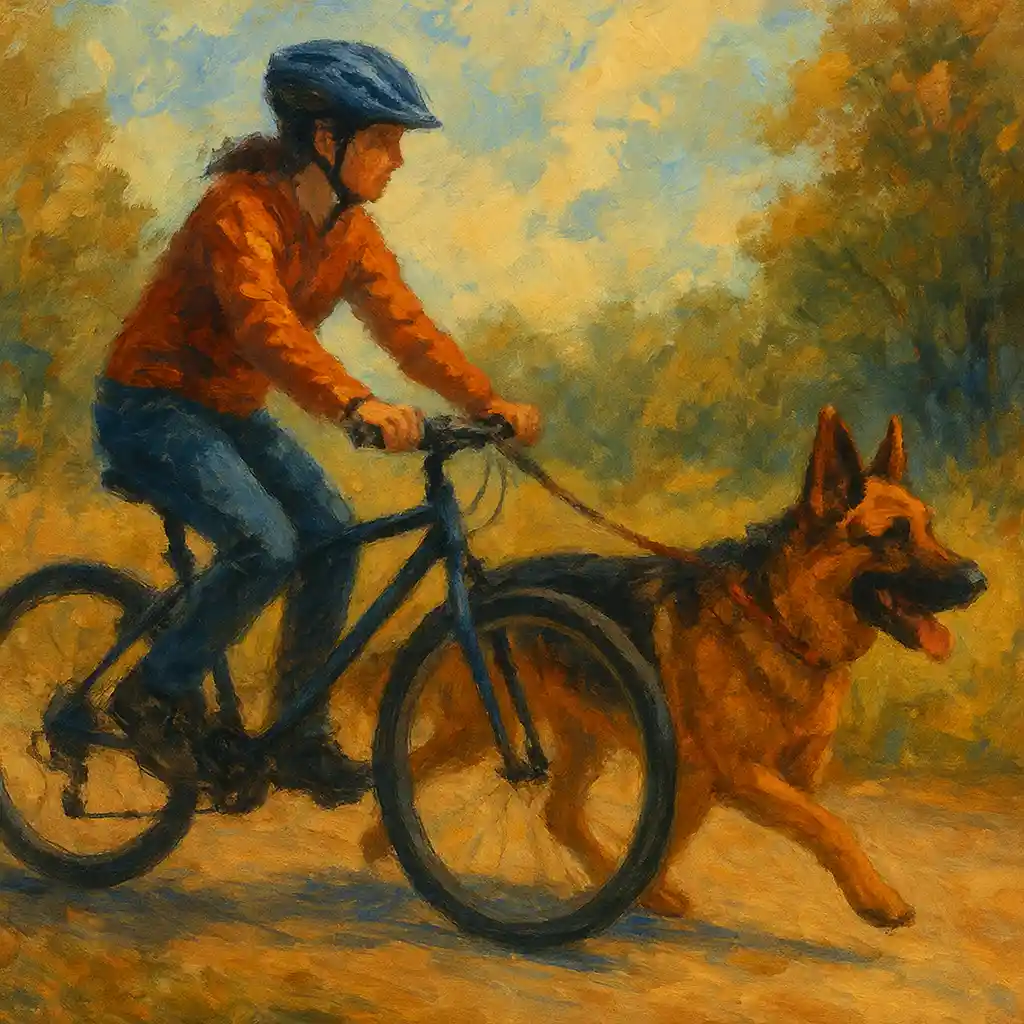
Biking with Your German Shepherd can be one of the best ways to exercise, build teamwork, and give your dog a job that matches their energy and intelligence. German Shepherd Dogs are athletic, focused, and loyal. They often enjoy moving with purpose, especially when they can do it with you.
At the same time, running next to a bicycle adds speed, wheels, traffic, and extra risks. A great ride is not about going fast. A great ride is about control, comfort, and trust.
- Position Training so your dog stays in the right place
- Leash Management so the line stays safe and untangled
- Speed Control so your dog runs at a healthy pace
You will also find warm-up and cool-down steps, hydration and feeding tips, route advice, safety gear, and solutions for common problems. The language stays clear and friendly, with strong added value for real life.
Why biking is great for German Shepherds
German Shepherds were bred to work. Many of them love movement that has structure and direction. A calm walk is good, but it may not be enough for some dogs, especially younger adults.
Benefits of Biking with Your German Shepherd include:
- Better fitness for both of you, with steady cardio and muscle work
- Mental stimulation because your dog must focus on position and pace
- Reduced boredom which can lower problem behaviors at home
- Stronger bond because you practice teamwork and communication
- A clear job that often suits the German Shepherd mindset
A safe routine can turn biking into a healthy habit for many years.
Start with health, age, and timing
Before you begin regular biking, make sure your dog is physically ready.
Vet and body readiness
- Ask your vet if your dog is fit for running, especially if your dog is senior, overweight, or has past joint issues.
- Avoid hard running with puppies. Many vets recommend waiting until growth plates are closed, often around 12 to 18 months, depending on the dog.
- Watch for signs of pain later in the day, like stiffness, limping, or refusing stairs.
Heat and surface safety
- Avoid hot weather. Dogs can overheat quickly when they run.
- Be careful with asphalt. It can burn paws when the sun is strong.
- Choose early mornings or evenings in warm seasons.
Senior dog owners and senior dogs
Many senior owners enjoy this sport with great success by keeping it gentle and controlled.
- Use a stable bike, smooth routes, and shorter distances.
- Keep speed moderate and avoid sharp turns.
- Consider a step-through frame for easier mounting and stopping.
- For older dogs, focus on short “trot sessions” instead of long runs.
Consistency and safety matter more than distance.
The three pillars of success
1) Position Training
Position is the foundation of safety. Your dog should know exactly where to be, every time, with no guessing.
The safest position for most teams is:
- Dog runs beside the bike, slightly behind the front wheel
- Dog stays on one chosen side, left or right
- Dog never crosses in front of the tire
Choose a side and keep it consistent. Many people choose the right side to keep the dog farther from traffic, but local roads and your own comfort also matter.
2) Leash Management
Leash handling must prevent:
- Tangling in wheels
- Sudden pulls that turn the bike
- Falls caused by line wrapping around legs or pedals
A normal hand-held leash is risky at speed. A safer setup usually includes:
- A hands-free waist leash with shock absorption, or
- A bike leash attachment made for running dogs, often with a spring to soften pulling
Always prioritize a setup that keeps the line away from spokes and brakes, and that allows quick control.
3) Speed Control
Your dog should run at a healthy, steady pace. Fast bursts look fun but can overload joints, pads, and muscles.
Speed control means:
- Starting slow
- Keeping a steady rhythm
- Stopping before your dog becomes exhausted
The best pace is the pace that lets your dog run smoothly with relaxed breathing and good form.
Equipment that makes biking safer
Biking with Your German Shepherd becomes much easier with the right gear. Avoid harsh tools that increase injury risk when speed is involved.
For your dog
- Well-fitted harness, preferably a Y-front or sport harness that allows free shoulder movement
- Reflective vest or reflective strips for low light
- ID tag and microchip for safety
- Paw protection when needed, especially on rough gravel or hot surfaces
Avoid choke chains and prong collars for bike running. A sudden pull at speed can hurt the neck.
For you and the bike
- Helmet every time
- Front and rear lights if visibility is low
- Bell to warn pedestrians early
- Good brakes and tire check before rides
- A stable bike you can stop quickly and control with one hand if needed
Leash options that work well
- Waist belt leash with bungee section for shock absorption
- Bike-mounted dog leash arm that holds the leash away from the wheel
Whichever option you choose, test it while standing still, then while walking, before you add speed.
Step-by-step training plan for biking
Training should feel simple and structured. Move forward only when your dog is calm at the current level.
Step 1: Create calm behavior around the bike
Many dogs get excited or nervous when a bike appears.
Practice in short sessions:
- Bring out the bike and reward calm behavior
- Walk the bike next to your dog and reward position
- Touch pedals, roll the bike a little, reward calm focus
Goal: your dog stays relaxed and attentive.
Step 2: Teach the position on foot
Start with walking, not riding.
- Put your dog in the chosen side position next to the bike.
- Use a clear cue such as “side” or “with me.”
- Take 5 to 10 steps, reward.
- Turn gently, reward again when your dog stays in place.
Keep sessions short. Many small wins build strong habits.
Step 3: Add the most important cues
Clear cues reduce sudden danger. Teach these before real rides.
Useful cues include:
- “Slow” to reduce pace
- “Stop” to halt
- “Leave it” for squirrels, cats, food, and trash
- “Wait” for crossings and corners
- “Easy” for calm focus when excited
- Directional cues like “left” and “right” if you want extra control
Train cues while walking first, then while jogging, and only later while biking.
Step 4: Start riding in a safe open area
Choose a quiet place like an empty parking lot, wide path, or calm park road.
Your first rides should be very short:
- 1 to 3 minutes of slow riding
- Stop and reward calm behavior
- Repeat once or twice
End the session early while your dog still feels good. This builds motivation and prevents overload.
Step 5: Build distance and routine slowly
A simple growth rule helps prevent injuries.
- Increase total running time by no more than 10 percent per week
- Include easy days between harder days
- Keep at least one full rest day each week for many dogs
A sample beginner plan for an adult healthy German Shepherd:
- Week 1: 3 to 6 short sessions, 5 to 10 minutes total each
- Week 2: 10 to 15 minutes total each
- Week 3: 15 to 25 minutes total each
- Week 4: 25 to 35 minutes total each, with breaks
Adjust for age, weather, and fitness.
Position Training in detail
Position is not only about staying beside the bike. It is also about staying predictable.
Where exactly should your dog be
A safe target position usually looks like this:
- Dog’s shoulder near your knee line
- Dog slightly behind the front wheel
- Enough room for your pedals to move freely
If your dog creeps forward, correct early and calmly. Forward movement increases the risk of cutting in front of the bike.
Training tips that work
- Reward the correct spot often in the beginning.
- Use a consistent side. Switching sides often slows learning.
- Use corners and curves as training moments. Many dogs drift on turns.
- Practice “stop and sit” at curbs and path crossings to create habits.
A German Shepherd that understands position becomes a confident running partner.
Leash Management that prevents accidents
Leash problems cause many falls. Good leash management is not about strength. It is about setup and habits.
Key rules
- Keep the leash short enough to prevent crossing in front, but long enough to avoid pulling the dog into the bike.
- Keep the line away from spokes and pedals at all times.
- Avoid wrapping the leash around your hand.
- Avoid sudden jerks. Use smooth braking and smooth cues.
Hands-free tips
A waist belt leash can work well if:
- The leash is attached on the side, not centered in front
- The bungee section reduces sudden impact
- You still have the ability to hold the leash briefly when needed
A bike-mounted leash arm can help keep a safe distance from the wheel. It can also reduce side pulls. Practice slowly first, since the feel is different.
Quick-release safety
Choose a system that allows fast release if something truly unsafe happens, such as:
- Another dog attack
- A crash where your dog could be pulled down
- A leash snag around an object
Safety planning is responsible, not pessimistic.
Speed Control without stress
Speed is exciting, but control is what keeps this activity enjoyable long-term.
Choose the right pace
A healthy running pace for many German Shepherds is a steady trot to a light run, depending on fitness. The best pace is the one where your dog:
- Runs smoothly without bouncing
- Keeps a relaxed, open mouth pant
- Does not lag behind
- Does not surge forward pulling hard
Use pace cues
Teach two different speeds early:
- “Easy” means slow down to a relaxed trot
- “Let’s go” means move forward at a working pace
Reward the dog for responding. Over time, your cues matter more than the environment.
Add breaks on purpose
Planned breaks prevent overexertion:
- Stop every 10 to 15 minutes in warm weather
- Stop less often in cool weather, but still offer short pauses
- Use breaks for water, sniffing, and a quick body check
Warm-up and cool-down routines
Many injuries happen at the start or end because the body changes speed too fast.
Warm-up, 5 to 10 minutes
- Start with a brisk walk
- Add 30 to 60 seconds of gentle trotting
- Do a few simple turns and stops to check focus
This warm-up also helps your dog settle mentally.
Cool-down, 5 to 10 minutes
- Slow down gradually
- End with a relaxed walk
- Offer water
- Let your dog sniff and decompress
Cooling down supports recovery and keeps the next day more comfortable.
Hydration and nutrition for active German Shepherds
Running next to a bike uses energy and water fast.
Hydration rules
- Offer water before the ride.
- Carry water and a collapsible bowl for longer sessions.
- Offer small drinks during breaks rather than one huge drink.
Food timing
- Avoid a full meal right before intense running.
- Many owners prefer feeding after the ride once the dog has rested a bit.
If your dog has a sensitive stomach, keep the routine consistent and avoid new treats on ride days.
Watch for dehydration and overheating
Stop immediately if you notice:
- Heavy panting that does not settle during rest
- Thick drool, dry gums, or sticky saliva
- Weakness, wobbling, or confusion
- Vomiting or refusal to continue
Heat issues are emergencies. Seek veterinary help if recovery is not quick.
Choosing the right route
Route choice can make the difference between calm teamwork and constant problems.
A good route has
- Wide paths with space to pass others
- Predictable surfaces, like packed dirt or smooth pavement
- Low traffic and few tight corners
- Shade and water access when possible
Avoid routes with
- Heavy pedestrian traffic where sudden stops are common
- Loose dogs off leash in busy areas
- Sharp gravel that can cut pads
- Very steep hills until your dog is conditioned
Start with quiet routes, then add more challenging areas as your dog improves.
Common challenges and practical solutions
Even a well-trained German Shepherd can get distracted. A plan helps you stay calm and consistent.
Pulling forward
Cause: excitement, too much speed, unclear position rules Fix:
- Reduce speed immediately
- Reinforce the correct position with rewards
- Practice “easy” and “side” during walking sessions again
- End sessions earlier for a few days so the dog stays successful
Sudden stops to sniff
Cause: the environment is too interesting, or your dog needs breaks Fix:
- Add planned sniff breaks so your dog gets what they want in a safe way
- Teach “leave it” and reward strongly
- Avoid routes with strong smells at first, like food trash zones
Lunging at squirrels, cats, or other dogs
Cause: prey drive, excitement, poor distance management Fix:
- Increase distance early, steer wide
- Use “leave it” before the lunge starts
- Slow down, stop if needed, regain focus
- Train impulse control off the bike with structured games and calm exposure
Fear of bikes or noise
Cause: lack of gradual exposure Fix:
- Go back to step 1, calm work around the bike
- Keep sessions short and positive
- Avoid forcing the dog to run when stressed
Getting tired too soon
Cause: too much distance, heat, fitness level, or health issues Fix:
- Cut distance in half for a week
- Ride in cooler times
- Add rest days
- Check pads and nails, and talk to your vet if fatigue is unusual
Real-life examples that show what works
Example 1: A senior owner with a calm routine
A retired owner and a six-year-old German Shepherd built a simple schedule. They rode three times per week on the same flat park loop. Every ride started with a 10-minute walk and ended with a cool-down. The owner used a waist belt leash and kept the pace steady. After two months, the dog showed better calmness at home and improved leash manners even on normal walks.
Key lesson: steady routine and moderate pace create long-term success.
Example 2: A high-drive young adult German Shepherd
A two-year-old German Shepherd started with too much excitement and pulled forward. The handler reduced speed and did two weeks of position practice while walking the bike. They also trained “leave it” daily with food and toys. When they returned to riding, the dog understood the job better and stayed behind the front wheel. The team then increased distance slowly.
Key lesson: going slower in training creates faster progress later.
Example 3: An older dog that needed joint-friendly sessions
A nine-year-old German Shepherd still loved to move but could not handle long runs. The owner switched to short trot intervals with long walk breaks. They chose soft trails instead of hard pavement and avoided downhill running. The dog stayed happy and active without soreness.
Key lesson: biking can work for seniors when the plan fits the body.
Safety checklist for every ride
Use this quick list before you start. It prevents small mistakes that lead to big problems.
Check your dog
- Harness fits well and does not rub
- Nails are trimmed enough for healthy footing
- Pads look normal, no cracks or cuts
- Energy is good and movement is smooth
Check your gear
- Leash system is secure and untangled
- Reflective gear is on if needed
- Water is packed for longer sessions
Check your bike
- Brakes work well
- Tires are firm
- Lights are working when needed
Check the environment
- Weather is safe, not too hot
- Surface is suitable for paws
- Route is not crowded
Making it enjoyable for years
Biking with Your German Shepherd is not only exercise. It is shared work, shared focus, and shared time outside. The secret is not speed or distance. The secret is building habits that protect your dog’s body and your own safety.
Keep these long-term habits:
- Train position like it matters, because it does
- Use safe leash systems and avoid risky hand-held setups
- Increase distance slowly and respect recovery days
- Warm up, cool down, and carry water
- Choose routes that support calm focus
- Stop early when your dog shows fatigue, stress, or heat load
Conclusion
A safe bike run with a German Shepherd looks smooth, calm, and controlled. It is built from position training, smart leash management, and steady speed control. Add good gear, a sensible route, warm-ups, cool-downs, and hydration, and you create a routine that improves both fitness and behavior.
With patience and consistent practice, this activity becomes a highlight of the week. It supports your German Shepherd’s body and mind, and it strengthens your connection through teamwork and shared movement.