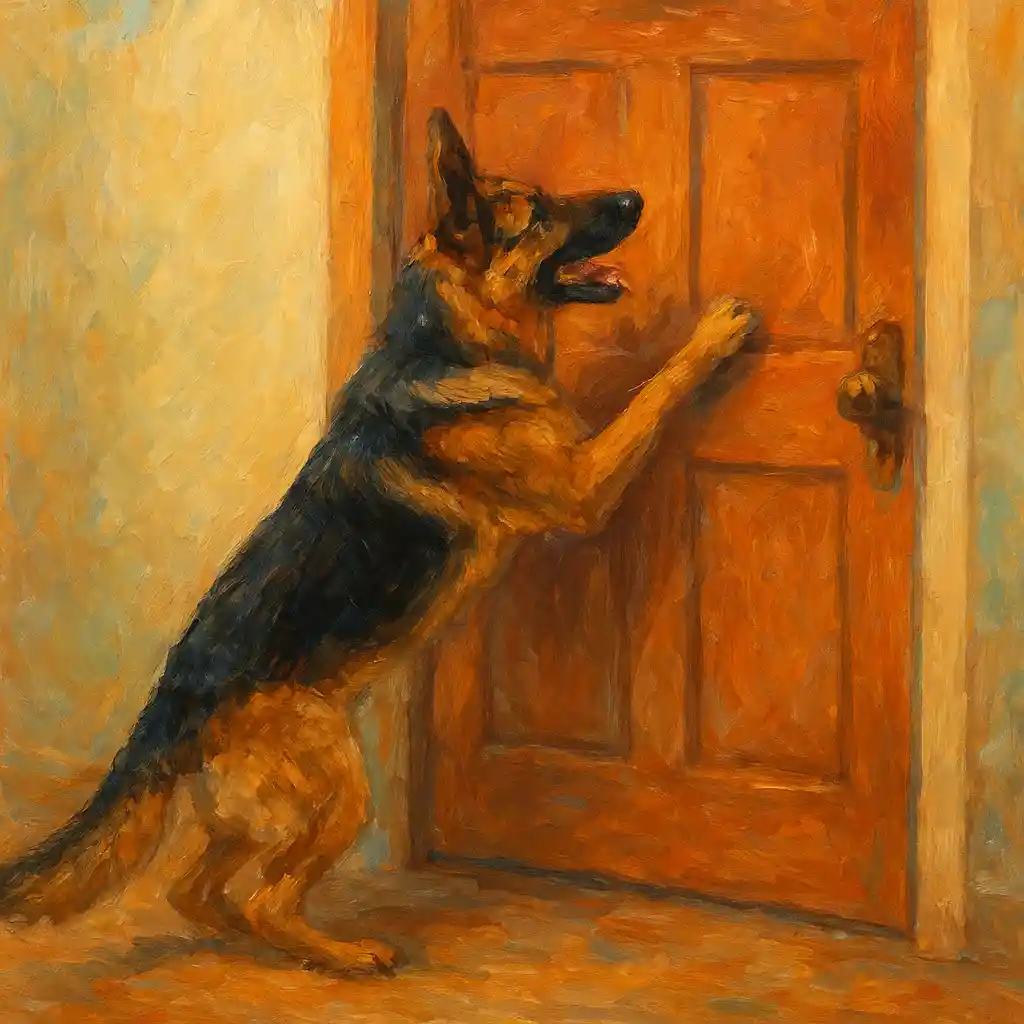
Living with a German Shepherd Dog (GSD) is a joy: they are smart, loyal, and full of personality. At the same time, many owners share one big daily challenge—GSD’s Door Excitement. The moment the doorbell rings or someone knocks, the energy can jump from “normal” to “full alarm.” Barking, rushing the door, spinning, jumping on guests, or trying to slip outside can turn a simple delivery into a stressful event.
Each dog presents unique challenges with GSD’s Door Excitement, and understanding these is key.
Many owners struggle with GSD’s Door Excitement when guests arrive, leading to chaos at the entrance.
The good news: you do not need a long, complicated program to see improvement. With a focused routine that takes about 10 minutes a day, you can teach calm, controlled behavior at the door. This article gives a plan built around three proven ideas:
- Place Training (go to a mat/bed and stay there)
- Impulse Control Game (practice waiting and self-control)
- Door Knock Practice (train with real triggers in a safe way)
You will also learn how to combine these strategies, avoid common mistakes, and keep the results long-term.
Addressing GSD’s Door Excitement through consistent training can transform your dog’s behavior.
Why GSD’s Door Excitement Happens
German Shepherds were bred to work. Many of them are naturally alert, protective, and quick to respond to changes in their environment. The front door is a “high-value zone”: it brings strangers, noise, movement, and emotional energy from humans.
Regular practice will greatly reduce GSD’s Door Excitement over time.
Effective management of GSD’s Door Excitement requires clear structure and guidance.
Understanding GSD’s Door Excitement is crucial for effective training.
Overcoming GSD’s Door Excitement requires patience and a structured approach.
Focusing on GSD’s Door Excitement can improve the overall quality of life for your dog.
Many factors contribute to GSD’s Door Excitement, including their protective instincts.
Common reasons GSD’s Door Excitement becomes intense include:
- Protective instincts: Your dog believes it is their job to respond.
- Over-arousal: The doorbell becomes a strong trigger that raises stress and excitement.
- Learned behavior: If barking and rushing the door has happened for months or years, it becomes a habit.
- Accidental rewards: Shouting, grabbing the collar, or pushing the dog away can still feel like attention and “success.”
- Lack of a clear job: Without a trained alternative behavior, the dog chooses the most natural option: rush, bark, react.
The goal is not to remove your dog’s personality or silence them completely. The goal is to teach a new pattern: doorbell = go to place, wait, then greet calmly (or stay calm while you handle it).
In addition, recognizing triggers of GSD’s Door Excitement can aid in training.
Safety First: Why This Training Matters
Door excitement is not only “annoying.” It can create real risks:
- Jumping on visitors: People can get scratched, knocked over, or frightened.
- Door dashing: A GSD can escape quickly and run into traffic or get lost.
- Stress and conflict: High arousal can lead to nipping, mouthing, or rough behavior.
- Poor visitor experiences: Guests may feel unsafe, even if the dog is friendly.
- Handler injury: Grabbing a lunging dog can strain shoulders, wrists, or back—especially for older adults.
Training is the kind option. It gives your dog a clear plan and helps them feel more secure.
The key to managing GSD’s Door Excitement lies in effective training strategies.
The 10-Minute Fix: How It Works
This approach works because it trains skills, not just “stop barking.” Your dog learns what to do instead of reacting.
Training for GSD’s Door Excitement ensures a more peaceful entry for everyone.
A simple daily structure:
Resolving GSD’s Door Excitement helps create a safer environment for everyone.
- 4 minutes: Place Training
- 3 minutes: Impulse Control Game
- 3 minutes: Door Knock Practice (easy level)
Ten minutes is enough for progress when practice is consistent and rewards are clear.
Important note: Results depend on the dog and the history of the behavior. Some dogs improve in days, others need weeks. The 10-minute routine is about daily progress and building a strong habit.
Strategy 1: Place Training (The Best Tool for Door Control)
What “Place” Means
“Place” is a cue that tells your dog to go to a specific spot—usually a mat, dog bed, or blanket—and stay there until released.
Why Place Training Helps GSD’s Door Excitement
Place Training gives your dog:
- A clear job
- A safe distance from the door
- A calmer body position (lying down is naturally calming)
- A predictable routine
It also gives you control without wrestling your dog.
What You Need
- A stable mat or dog bed (non-slip is best)
- Small tasty treats (soft and easy to chew)
- A calm voice and steady timing
Step-by-Step: Teach “Place” From Scratch
Step 1: Build value for the mat
Addressing GSD’s Door Excitement also involves understanding canine behavior.
- Put the mat on the floor.
- When your dog looks at it or steps on it, mark and reward (say “Yes” or use a clicker).
- Toss another treat away to reset, then reward again when the dog returns.
Do this for 1–2 minutes. Keep it easy and positive.
Step 2: Add the cue
- When your dog is moving toward the mat, say “Place.”
- The moment they get onto the mat, reward.
- Repeat several times.
Step 3: Add a short stay
- Reward your dog for staying on the mat for 1 second.
- Then reward for 2 seconds, then 3 seconds.
- If your dog steps off, simply reset and try again at an easier level.
Step 4: Add a release word Choose a release cue like “Free” or “Okay.”
- Reward the dog while they stay on the mat.
- Say “Free” and encourage them to move off.
- Reward again after they move off (this keeps the release positive).
Place Training for the Door (The Door Version)
Once your dog understands Place in quiet times, connect it to door situations:
- Put the mat 6–10 feet away from the door (not right next to it).
- Walk to the door and back while your dog stays on Place.
- Touch the doorknob, return, reward.
- Open the door 1 inch, close it, return, reward.
- Slowly build up: open wider, step outside briefly, come back, reward.
This teaches your dog that door movement is normal and that calm behavior pays.
Strategy 2: The Impulse Control Game (Self-Control That Transfers to the Door)
Impulse control means your dog can feel excitement but still choose a trained behavior. This is the missing piece for many dogs with GSD’s Door Excitement.
The Core Game: “Wait for It”
This is simple, fun, and powerful.
How to play:
- Hold a treat in your closed hand.
- Let your dog sniff or nudge (no scolding).
- The moment your dog stops pushing and backs off even slightly, mark (“Yes”) and give a treat from the other hand.
- Repeat until your dog quickly backs away and waits.
Then make it slightly harder:
- Open your hand a little.
- If the dog dives in, close your hand again.
- Reward calm waiting.
This teaches: calm choices earn rewards.
Add a Door-Friendly Cue: “Wait”
Once the game makes sense, use it near the door.
Practice:
- Ask your dog to sit.
- Say “Wait.”
- Reach for the door handle.
- If your dog holds position, reward.
- If your dog breaks position, calmly reset.
This builds “brakes,” which are essential for controlling door behavior.
Extra Impulse Control Options (Short and Useful)
Rotate these to keep training interesting:
- Food bowl wait: dog waits politely before eating
- Toy wait: dog waits before grabbing a toy
- Stay with movement: you take one step back, then return and reward
- Look at me: reward eye contact when exciting things happen
You do not need all of these every day. Use one small game per session.
Strategy 3: Door Knock Practice (Train the Trigger, Not Just the Idea)
Many dogs behave perfectly in the living room and fall apart when the doorbell rings. That happens because the trigger is too strong. Door Knock Practice fixes this by training with realistic sounds and movements, starting at an easy level.
What You Need
- A helper (friend, neighbor, family member) or recorded knock/doorbell sound
- Treats
- Your dog’s Place mat
The Right Training Progression (Very Important)
Start easy. Success builds confidence.
Level 1: Soft knock / quiet doorbell sound
- Put your dog on Place.
- Ask for calm (sit or down).
- Helper makes a soft knock once.
- Immediately reward calm behavior on the mat.
- Repeat 5–10 times, then stop.
If your dog explodes, the knock was too strong or you moved too fast. Lower intensity and increase distance.
Level 2: Normal knock Repeat the same steps with a more realistic knock.
Level 3: Knock + door handle Add the sound of the handle moving, then reward calm.
Level 4: Knock + door opens slightly Open the door a little, close it, return, reward.
Level 5: Helper appears briefly Your helper shows their face, then disappears. Reward calm.
Level 6: Real entry Your helper steps in calmly. You keep rewarding your dog for staying on Place.
This creates a new emotional pattern: knock = focus and earn rewards, not chaos.
Putting It Together: The Best 10-Minute Routine (Daily Plan)
Here is a simple, repeatable plan that fits into daily life.
Minute 0–4: Place Training
- 6–10 repetitions of “Place”
- Reward for staying 2–10 seconds
- Add one door-related action (touch handle, step toward door)
Minute 4–7: Impulse Control Game
Choose one:
- Closed-hand treat game (“Wait for it”)
- Sit-stay while you reach for the handle
- “Look at me” for calm focus
Minute 7–10: Door Knock Practice
- 5–10 easy knocks (low intensity)
- Reward calm behavior on the mat
- End before your dog becomes tired or frustrated
Stop while it is going well. That keeps training positive and makes the next session easier.
Calm Greeting Rules (When You Do Want Your Dog to Say Hello)
Some families want a controlled greeting. That is possible, but it must be earned.
A simple greeting system:
- Dog stays on Place while you open the door and greet the person.
- Visitor ignores the dog at first (no excited talking, no fast petting).
- If the dog is calm, you release with “Free.”
- If the dog jumps, greeting ends and the dog returns to Place.
This teaches your GSD that calm behavior makes greetings happen.
Common Mistakes That Slow Progress (And What to Do Instead)
Fixing GSD’s Door Excitement is straightforward, but a few common mistakes can block results.
Mistake 1: Moving too fast
If your dog fails repeatedly, the training level is too hard.
Do instead:
- Lower the intensity of the knock
- Increase distance from the door
- Reward more often
- Shorten sessions
Mistake 2: Only training when visitors arrive
Real-life situations are usually too intense for learning.
Do instead:
- Practice daily with planned sessions
- Keep real visits calm and managed (leash, baby gate, or crate if needed)
Mistake 3: Repeating cues
Saying “Place, place, place!” teaches the dog to wait you out.
Do instead:
- Say the cue once
- Guide the dog calmly if needed
- Reward when they succeed
Mistake 4: Accidentally rewarding excitement
Petting, eye contact, or talking during jumping can act like a reward.
Do instead:
- Reward calm positions (sit/down on Place)
- Keep greetings low-energy
Mistake 5: Using punishment in high arousal moments
Harsh corrections can increase stress and make the door feel even more intense.
Do instead:
- Use structure (Place + leash management)
- Use rewards and repetition to build a habit
- Aim for calm confidence, not fear
Extra Safety Tools That Help (Especially During Early Training)
Training is a process. While your dog is learning, management keeps everyone safe.
Useful tools:
- Leash indoors during expected deliveries
- Baby gate to create space from the door
- Crate if your dog is crate-trained and relaxed there
- Treat jar near the door so rewards are always available
- Non-slip mat so Place feels stable and comfortable
Management is not failure. It prevents bad rehearsals and supports learning.
Added Tips for Seniors and Anyone Who Wants Easier Handling
For older adults, or anyone who prefers low-impact training, this plan is especially helpful because it reduces physical struggle.
Practical suggestions:
- Keep treats at waist height in a pouch to avoid bending often.
- Choose a thicker bed or mat that is comfortable for older dogs.
- Reward calm behavior often so your dog stays motivated.
- Train when the home is quiet, not when you feel rushed.
- Use a gate to avoid needing to hold a strong dog near the door.
A calmer door routine protects joints, reduces falls, and makes daily life smoother.
How to Maintain Results Long-Term (So It Does Not Come Back)
GSD’s Door Excitement can return if the dog stops practicing and starts rehearsing the old behavior again. The solution is easy: short refreshers.
A simple maintenance schedule:
- 3–4 days per week: 5-minute Place refresher near the door
- 1–2 days per week: Door Knock Practice (easy level)
- Any day: quick impulse control game before meals
Also:
- Reward calm door behavior randomly (not every time, but often enough).
- Keep rules consistent across the household.
Consistency makes calmness a lifestyle, not a temporary trick.
When to Get Professional Help
Some dogs need extra support, and getting help early can save time and stress.
Consider a professional trainer or behaviorist if:
- The dog shows aggressive behavior (growling, snapping, lunging with intent)
- The dog’s arousal is extreme and cannot recover quickly
- There is a bite history
- You feel unsafe handling your dog
- Progress is not happening after several weeks of consistent work
Look for a trainer who uses modern, evidence-based methods and prioritizes safety and welfare.
Real-Life Results You Can Expect
With daily practice, many owners notice changes like:
- Less rushing to the door
- Faster response to “Place”
- Shorter barking episodes
- Improved focus on the handler
- Safer greetings and fewer accidents
The biggest win is not perfect silence. The biggest win is a dog who can hear the doorbell and still choose a trained behavior.
Summary: The Calm Door Plan That Works
To reduce GSD’s Door Excitement, focus on three skills:
- Place Training: your dog learns exactly where to go and what to do
- Impulse Control Game: your dog learns to wait and think before acting
- Door Knock Practice: your dog learns calm behavior with real triggers
Use the 10-minute daily routine, keep sessions easy enough for success, and manage the environment while your dog is still learning. Over time, the door stops being a daily battle and becomes a normal moment.
With the right techniques, you can reduce GSD’s Door Excitement effectively.
Through patience and practice, you can manage GSD’s Door Excitement effectively.
Managing GSD’s Door Excitement is essential for a harmonious household.
Addressing GSD’s Door Excitement can also enhance your dog’s confidence.
Ultimately, training to control GSD’s Door Excitement results in a happier dog.